

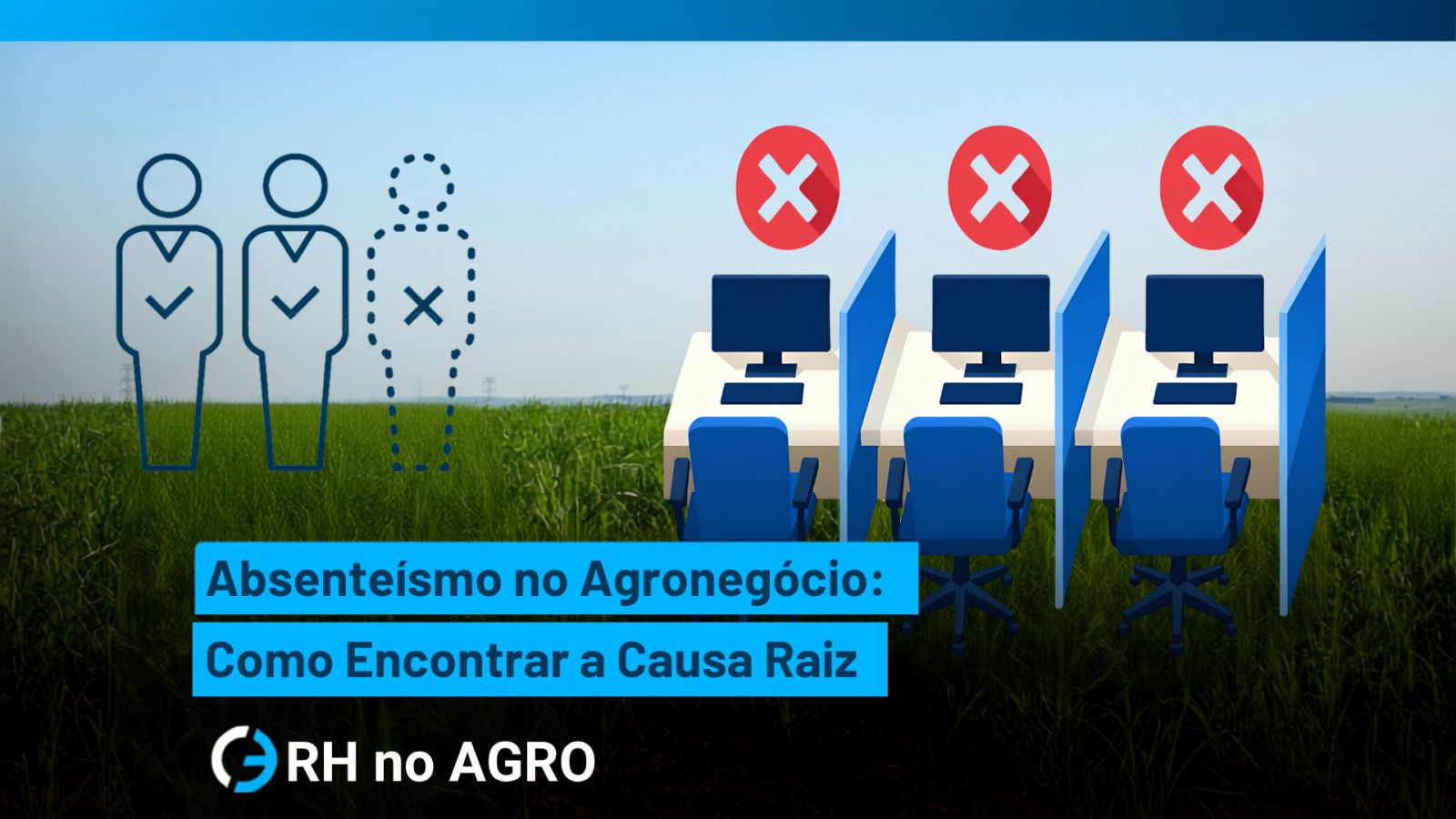
HR teams often treat absenteeism in agribusiness as a discipline problem, when in most cases it is a symptom of something else: poor working conditions, unprepared leadership, an undiagnosed health issue or simply a lack of connection between the employee and the purpose of that specific role.
Companies that respond to absenteeism only with stricter time tracking and payroll deductions usually see the number drop for a few weeks and climb again soon after, because the root cause was never addressed. The symptom was suppressed, not solved, and it comes back as soon as the pressure of control eases.
How to calculate and interpret absenteeism in agribusiness
The calculation itself is simple: divide the total hours or days not worked due to absence by the total hours or days that should have been worked in the period, then multiply by 100. The real difficulty is not the formula but the interpretation, because the same number can mean completely different things depending on the context of each site.
A high absenteeism rate at a newly opened site, still without established leadership, tells a different story from the same rate at an older site that always had a low rate and suddenly started to rise. Treating both cases with the same standard response is a common HR mistake when the number is viewed in isolation, without comparing it with the history of that specific operation.
The most common causes of absenteeism in agribusiness that HR overlooks
According to surveys by the Brazilian Confederation of Agriculture and Livestock (CNA), health issues and working conditions are among the factors most associated with absence in rural and agro-industrial operations, ahead of purely disciplinary reasons. This reinforces that investigating the cause before creating a policy is more effective than tightening the rules for everyone equally.
- Focuses on deductions and warnings for those who miss work
- Lowers the number in the short term without solving the cause
- The rate tends to rise again after a while
- Increases resentment without improving real conditions
- Breaks the data down by site, shift and role
- Compares absenteeism with engagement and local leadership
- Identifies whether the cause is health, conditions or motivation
- Solves the problem at the root, with a longer-lasting effect
How to structure an absenteeism diagnosis by site in agribusiness
The first step is to break the data down beyond the national total: by site, by shift and, whenever possible, by direct manager. A common and revealing pattern is when absenteeism concentrates in teams under the same supervisor, which usually points to a local management problem rather than a workforce-wide one.
The second step is to compare this data with other existing metrics, such as turnover and engagement survey results, a practice already discussed in our article on people analytics in agribusiness. Sites with high absenteeism and high turnover at the same time are rarely a coincidence: they usually share the same root cause, whether unprepared leadership or inadequate working conditions. Among managers of isolated sites, this pattern is sometimes linked to burnout, recognized by the World Health Organization as an occupational phenomenon resulting from chronic workplace stress that has not been successfully managed.
Most common mistakes in managing absenteeism in agribusiness
Creating a punitive policy before investigating the cause: it treats the symptom temporarily and ignores the real problem behind the absences.
Looking only at the company-wide total: averages hide sites with serious problems being offset by healthy ones.
Not comparing absenteeism with direct leadership: it ignores that much of the variation comes from the quality of local management, not from the workforce itself.
Applying the same yardstick to every absence: short recurring absences and long-term leave have different causes and solutions.
How to talk to an employee about recurring absences
Before any formal measure, a well-conducted one-on-one conversation usually reveals more than any report. Asking directly, without an accusatory tone, whether there is a specific difficulty preventing regular attendance gives the employee room to mention something HR would hardly find out otherwise, such as transportation problems, a family situation or discomfort with their direct manager.
Documenting this conversation, even in a simple way, also protects the company if a disciplinary measure becomes necessary later, showing there was a genuine attempt to understand the cause before any penalty. This care usually reduces significantly the number of cases that escalate to dismissal for cause related to absences.
Conclusion
Absenteeism in agribusiness is truly solved when HR investigates the root cause behind the number, not when it simply tightens attendance control. Breaking the data down by site, comparing it with other metrics and treating short absences and long-term leave as distinct problems is what turns this metric into a real diagnostic tool, instead of just another enforcement number.
If your company needs to structure people management with decisions based on real data, Geração C3 can help. We specialize in recruitment and selection exclusively for Brazilian and Latin American agribusiness.