

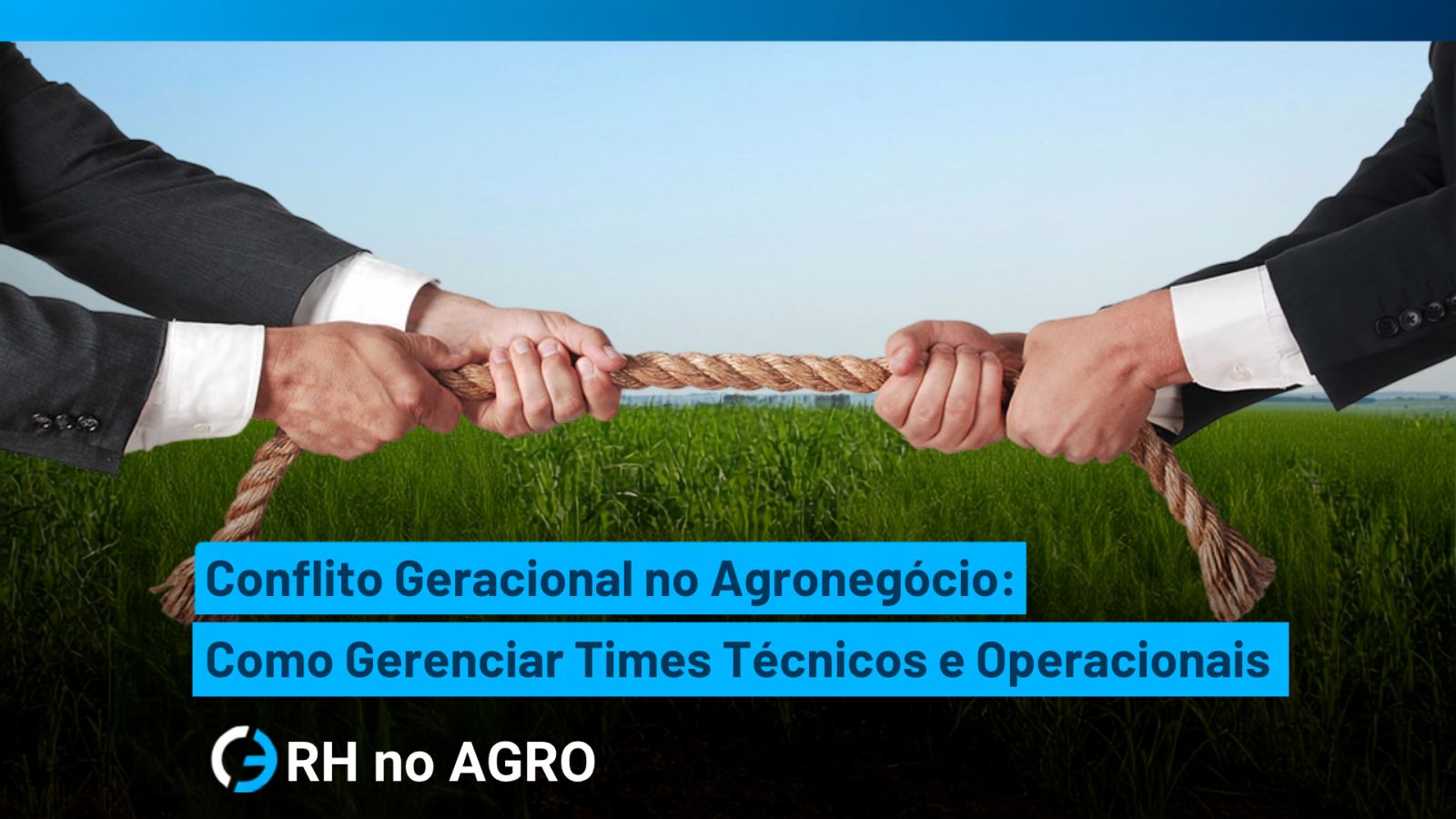
Generational conflict in agribusiness shows up more and more often as companies in the sector combine, in the same operational or technical team, employees who entered the job market decades ago with others who started only a few years ago, each group carrying different expectations about hierarchy, communication and the use of technology.
The problem is rarely the age difference itself. It is the absence of a deliberate effort to translate expectations between generations, which makes behaviors that are normal for one group look like disrespect or lack of commitment to the other, when in fact they simply reflect different backgrounds and contexts.
How generational conflict in agribusiness shows up in practice
In technical and operational teams, friction usually arises around a few recurring themes: how quickly new digital tools are adopted, the preferred way of receiving instructions (verbal and direct versus documented and written), and expectations about how much personal life should influence decisions about schedules and working hours.
More experienced employees tend to value know-how built up in practice and to distrust changes that have not proven clear value. Younger employees tend to question legacy processes and expect more flexibility and purpose at work, which can be misread as impatience or lack of discipline by those who come from a different work culture.
Why assuming a "lack of commitment" is a common mistake
It is tempting to label younger employees as less committed when they question a rule or ask for more flexibility. Research on the intergenerational workforce, such as studies by Deloitte, shows that commitment across generations is generally equivalent; what changes is only how it is expressed and what each group expects in return for the effort it invests.
Treating this difference in expression as an attitude problem, instead of recognizing it as a different cultural expectation, tends to widen the distance between generations rather than resolve it, a pattern similar to the one discussed in our article on DISC in agribusiness team management, where hasty judgments about behavioral style also mask the real potential for collaboration between different profiles.
Reverse mentoring as a practical tool
One of the most effective formats for reducing generational conflict is reverse (or cross) mentoring, in which more experienced employees teach practical know-how and the history of the operation, while younger employees support the adoption of digital tools and new processes. This model intentionally inverts the traditional hierarchy of knowledge, which helps each group see real value in the other's contribution.
Informal cross-mentoring programs, without excessive bureaucracy, tend to work better than formal, mandatory initiatives, which may be perceived as an imposition rather than a genuine exchange between colleagues.
Cross mentoring
Practical experience traded for technological familiarity between generations.
Explicit communication
Making expectations visible keeps differences from being read as disrespect.
Hands-on training
Resistance to new tools is usually a lack of training, not refusal.
Mixed teams
Combining generations usually outperforms homogeneous teams on operational results.
The direct manager's role in mediation
Much of the generational conflict in technical and operational teams could be avoided with active mediation by the direct manager, before small disagreements turn into accumulated resentment. This requires the manager to be alert to signs of friction, even when no one files a formal complaint, and to handle the topic naturally, without automatically taking the side of one generation over the other.
Managers who publicly recognize the value of different generations, instead of reinforcing stereotypes, usually build more cohesive teams and retain talent from both groups for longer, a topic related to the one discussed in our article on leadership competencies in agribusiness. Research from SHRM (Society for Human Resource Management) reinforces that teams led by managers specifically trained in managing generational conflict, in agribusiness and other sectors, have lower turnover at both age extremes of the team.
Communication differences that fuel generational conflict in agribusiness
Much of the friction between generations in technical teams does not come from real disagreement about the work but from incompatible communication styles. More experienced employees often prefer direct, verbal instructions, given in person by the manager or a senior colleague, while younger employees often expect written documentation they can access at any time without having to ask anyone.
When these preferences are not explicitly recognized, each generation tends to interpret the other's style as a personal failing: a younger employee who asks for everything in writing may seem distrustful or not very proactive to a more experienced colleague, while a more experienced employee who only explains things verbally may seem reluctant to document processes to a younger colleague. Neither reading is usually true, but both build up distrust if they are not named and discussed openly by the team's leadership.
A simple practice that reduces this kind of friction is to combine both formats by default: every relevant instruction is given verbally and then recorded in writing in a channel the team can access. This meets the preferences of both generations without requiring either one to give up the format it finds most natural, and it reduces the chance of rework caused by lost or poorly conveyed information.
4 steps to mediate a generational conflict that has already set in
Name the pattern, not the person
Describe the observed behavior without attributing bad intent to someone who acts differently because of their generational background.
Listen to both generations separately
Understand each side's reading before proposing any change to routine or process.
Agree on a hybrid format
Define, together with the team, a practical rule that meets both communication preferences.
Review in a few weeks
Confirm whether the adjustment really reduced friction, rather than just changing its form.
How recruitment can reduce generational conflict even before hiring
Much of the prevention of generational conflict in agribusiness happens before the person is hired, not after. Selection processes that explicitly assess the candidate's ability to work well with colleagues from different generations, and not just isolated technical competence, tend to build teams with significantly less day-to-day operational friction.
This requires specific interview questions about previous experiences of intergenerational collaboration, not just generic questions about teamwork, which rarely reveal how the person really reacts to work styles different from their own. A well-designed recruitment and selection process can pick up this signal before hiring, preventing the conflict from only showing up months later, already within the operation, when it is more costly and harder to correct.
This care connects directly to the topic of compatibility beyond technical competence, already discussed in our article on cultural fit versus job fit in agribusiness, where behavioral compatibility with the existing team appears as a factor as relevant as the candidate's technical qualifications alone.
Signs the problem has gone beyond natural disagreement
Some difference of opinion between generations is healthy and even desirable, since it combines complementary perspectives on the same operational problem. The manager needs to recognize, however, when this natural disagreement has evolved into something more serious: recurring dismissive comments about the ability of a younger or older colleague, the spontaneous formation of cliques that avoid working together, or a noticeable drop in the quality of communication between parts of the team that used to work well together.
These signs rarely appear explicitly in a formal meeting. They show up in everyday behavior, such as someone being systematically ignored in decisions that should include them, or repeated jokes that carry contempt disguised as humor. An attentive manager picks up these patterns before they become part of the team's informal culture and intervenes with one-on-one conversations instead of waiting for the problem to resolve itself.
Studies by the Pew Research Center on generational differences show that much of what is perceived as a conflict of values is, in practice, a difference in the historical context each generation lived through during its professional formation, not a real incompatibility of work principles.
Conclusion
Generational conflict in agribusiness is not solved by separating generations or trying to standardize behavior. It is solved with explicit communication of expectations, active mediation by the manager and formats such as cross mentoring, which turn difference into real complementarity within the team.
If your company needs to better structure the management of multigenerational teams, Geração C3 can help. We specialize in recruitment and selection exclusively for Brazilian and Latin American agribusiness.