

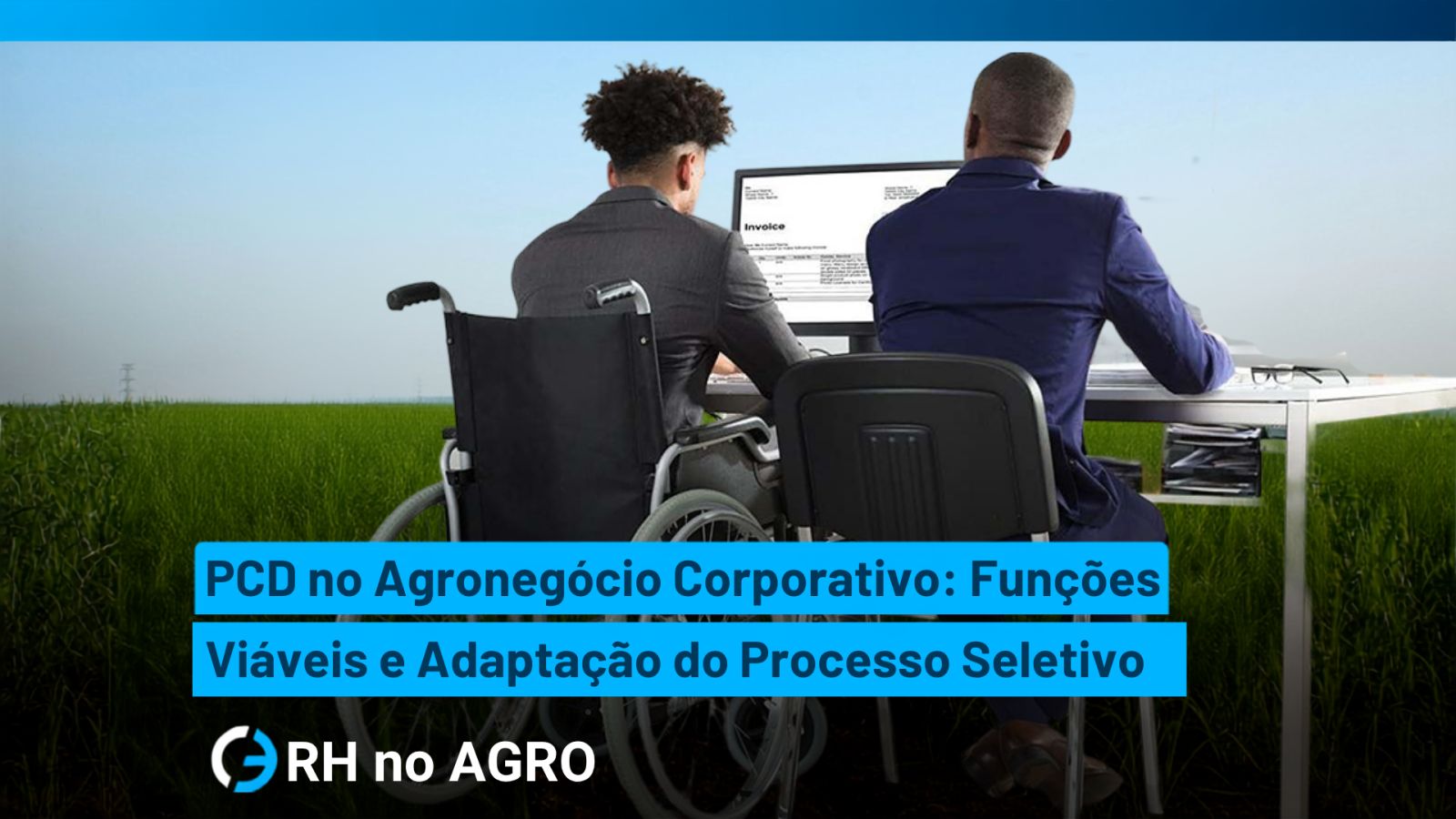
At many companies in the sector, hiring people with disabilities in agribusiness is still treated as a legal obligation to be met in the simplest way possible, rather than a real opportunity to widen the available talent pool. This limited framing leads to hires concentrated in a few administrative roles, leaving out a larger universe of technical and operational positions that could be adapted with relatively little effort.
Brazil's Quota Law, set out in Article 93 of Law 8.213/91, requires companies with one hundred or more employees to reserve positions for people with disabilities, with a percentage that varies according to the size of the workforce. Complying with the law is the minimum expected; the real challenge is turning this requirement into inclusion that actually works in day-to-day operations.
The risk of hiring people with disabilities in agribusiness just to meet the quota
Hires made only to reach the legal percentage, without a real assessment of the compatibility between the role and the candidate's profile, tend to result in high turnover and frustration on both sides. The person hired quickly realizes the role was not designed for them, and the company wrongly concludes that "people with disabilities do not adapt" to the operation, when the real problem was the lack of planning before hiring.
This pattern repeats itself frequently in operations that treat the quota as a number to be filled in a compliance report, instead of treating it as the starting point for a structured inclusion process, with stages for adapting the role, the physical environment and the team culture.
How to identify viable roles within the operation
The first real step toward effective inclusion is mapping, within the company's organizational chart, which roles are actually compatible with different types of disability, instead of assuming in advance that only administrative positions are suitable. Technical roles in quality control, planning, data analysis and remote supervision, for example, are often highly viable and underused in this process.
- Positions for people with disabilities concentrated only in administrative roles
- Hiring done under pressure from an inspection deadline
- No prior adaptation of the physical environment
- No post-hire follow-up
- Technical and operational roles also mapped
- Adaptation planned before the position is opened
- Physical environment adjusted in advance
- Formal follow-up in the first months
Adapting the selection process, not just the role
Effective inclusion of people with disabilities in agribusiness does not end with defining the role. The selection process itself needs adapting: job ads with inclusive language, accessible interview stages, and evaluation criteria focused on real competence for the role, not on generic assumptions about limitations based only on the type of disability reported.
A recurring mistake is applying the same standard selection process to people with disabilities without any adjustment, and then eliminating candidates for difficulties that stem from the process's lack of accessibility, not from any real inability to perform the role, a topic that connects to the one discussed in our article on looking beyond the resume when hiring in agribusiness, where superficial screening criteria also eliminate good candidates for reasons unrelated to their real technical ability.
Onboarding and the role of the existing team
Hiring is not the end of the inclusion process. The first months of an employee with a disability in a new role are decisive for whether they stay, and this depends directly on how the existing team was prepared to welcome them. Colleagues who do not know how to offer appropriate support, or who are overprotective to the point of limiting the person's autonomy, do as much harm as a total lack of support.
A well-structured onboarding for this reality includes an open conversation with the team before the new employee arrives, practical environmental adjustments already tested, and a clear point of contact for questions, practices related to the broader integration process discussed in our article on onboarding in the first 90 days in agribusiness.
Remote sites and the challenge of physical accessibility
Agribusiness companies with decentralized operations face an additional challenge: ensuring physical accessibility and adequate transportation at sites often far from urban centers, where accessibility infrastructure may be more limited. This does not make inclusion impossible, but it requires environmental adaptation to be part of the position's planning from the start, not a later correction after the problem has already appeared.
Companies that do this planning in advance, including reviewing access routes, adapted restrooms and appropriate signage, are able to open positions for people with disabilities at operating sites that previously seemed unfeasible only for lack of a detailed prior assessment of the available physical space.
The direct manager's role in retaining people with disabilities in agribusiness
Even with a well-defined role and an adapted physical environment, whether an employee with a disability stays depends heavily on how the direct manager runs the team day to day. A leader who treats the person naturally, without infantilizing them or ignoring real needs for adjustment, creates the conditions for the hire to work like any other, based on performance and not on condescension.
Managers unprepared for this context tend to make two opposite mistakes: either they avoid giving critical feedback for fear of seeming insensitive, which deprives the employee of real development, or they informally exclude the person from challenging tasks based on unverified assumptions about their ability. Both mistakes, though well intentioned, undermine the inclusion of people with disabilities in agribusiness as much as a total lack of structural adaptation.
Training managers specifically for this reality, with practical guidance on communication and task delegation, tends to have a greater impact on retention than any isolated infrastructure adjustment, because it is the everyday relationship with leadership that determines whether the person feels like a real part of the team or just a statistic in a filled quota.
Recurring mistakes that undermine the inclusion of people with disabilities in agribusiness
Besides rushed hiring just to meet a number, some mistakes repeat frequently at companies in the sector: treating adaptation as a cost to be minimized rather than an investment with returns in productivity and retention; concentrating all positions for people with disabilities in a single area of the company, creating isolation instead of integration; and not offering the same career development path available to other employees, as if the role were necessarily a dead end.
Correcting these patterns requires treating the inclusion of people with disabilities in agribusiness as part of the normal people management strategy, with the same development, evaluation and recognition criteria applied to any other employee, adjusted only where technical adaptation is truly necessary.
How specialized recruitment helps in this process
Companies without a dedicated internal structure to map roles, adapt selection processes and guide managers on this topic often outsource this stage to specialized recruitment firms, which have already built up a repertoire on which adaptations work best for each type of role and disability profile. This reduces the learning time the company would need to develop this competence internally from scratch.
An experienced firm also helps avoid common pitfalls, such as underestimating the viability of a role based on unverified assumptions, or overestimating the need for adaptation in cases where a simple adjustment would already solve the problem. This kind of correct calibration, based on experience accumulated across many previous processes, tends to significantly accelerate the company's maturity curve on this topic, avoiding both excessive caution and poorly made hires due to a lack of proper technical assessment of the real compatibility between role and candidate profile.
This external support also makes it easier to collect objective data on what really works within the operation itself, information the company can retain and apply in future hires, making the process less and less dependent on external support as internal maturity on the topic grows with the experience accumulated over successive hiring cycles.
Conclusion
Hiring people with disabilities in agribusiness works when the company goes beyond minimum compliance with the legal quota and treats inclusion as a structured process: mapping viable roles, truly adapting the selection process, preparing the existing team and following up after hiring. Companies that invest in these steps reduce turnover and genuinely widen their access to qualified talent.
If your company needs to structure an inclusion process for people with disabilities that really works, Geração C3 can help. We specialize in recruitment and selection exclusively for Brazilian and Latin American agribusiness.