

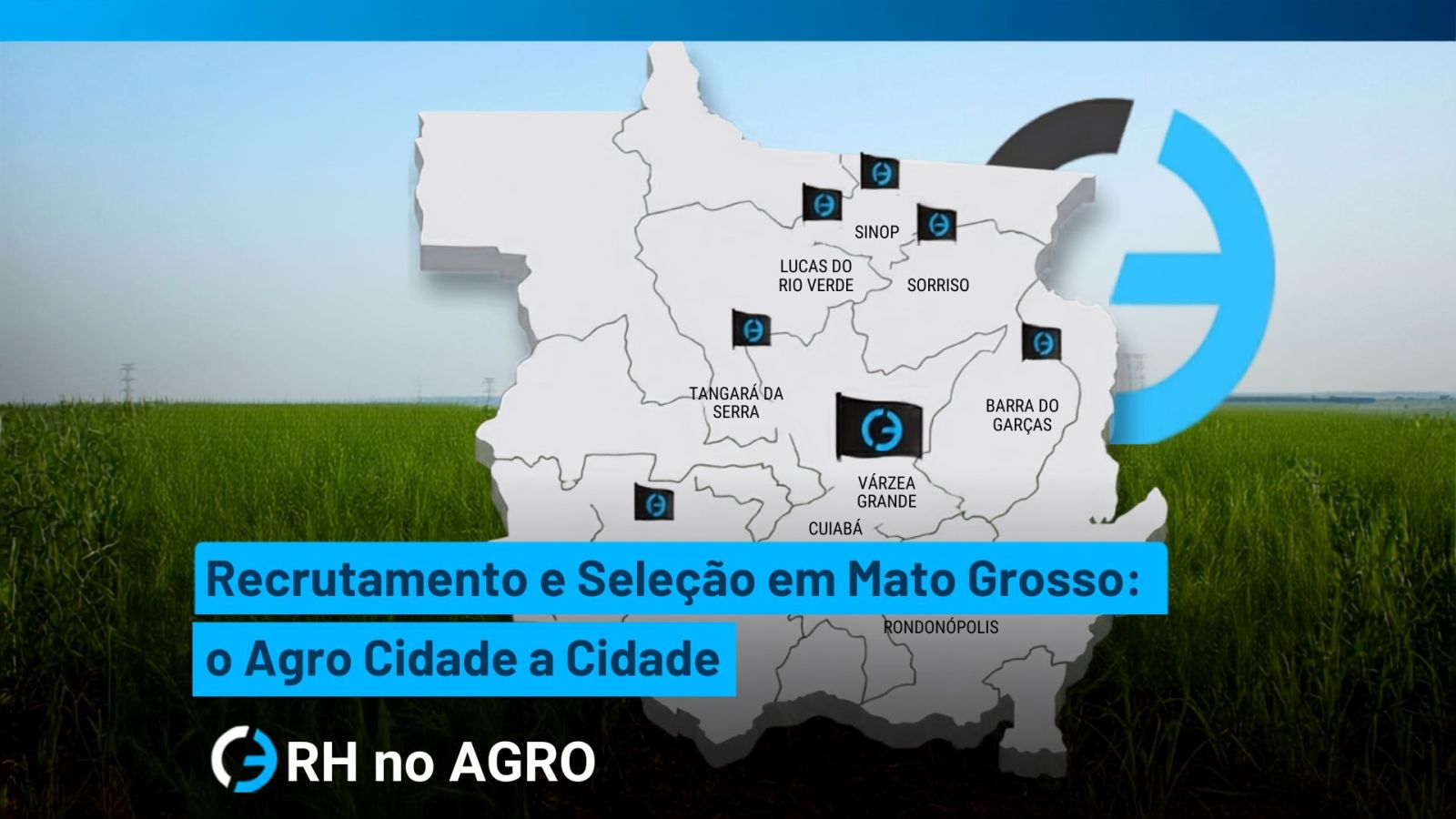
Recruitment and selection in Mato Grosso, in Brazil's Center-West, cannot be treated as a single process for the whole state, and the numbers explain why. Mato Grosso is the state that produces the most for Brazilian agribusiness, having generated R$ 116.5 billion in agricultural goods in 2023, equivalent to 14.3% of all national agricultural production. Recruiting an executive or a technical specialist for this territory, larger than many countries, without understanding the vocation of each hub means treating Sorriso, Rondonópolis and Sapezal as if they were interchangeable, when in practice each one requires a different kind of professional.
This is the kind of nuance that separates a generic selection process from true executive recruitment: understanding the real economy of each region before going out to look for resumes.
Map with the real geographic outline of the state of Mato Grosso — city positions are approximate within the outline, not to precise cartographic scale.
Why Mato Grosso concentrates so much strategic agribusiness talent
The answer lies in the combination of territorial scale, soil correction technology and decades of investment in logistics and grain origination. Mato Grosso is not only Brazil's largest producer of soybeans, corn and cotton; it is also where many of the strategic decisions of these chains are made, within the state itself. For executive recruitment, this means that a large share of the most strategic positions in Brazilian agribusiness is concentrated in specific regional hubs, each with its own business culture.
Looking at the state as a whole, this complexity can be organized into four major economic clusters, each with its own dominant vocation. This division is not official, but it is the most useful way to see Mato Grosso from a recruiter's point of view: each cluster concentrates a different type of company, candidate and labor market dynamic.
Sorriso: Brazil's agribusiness capital
Sorriso leads the national ranking of municipal agricultural GDP, with R$ 8.3 billion in production value, ahead of any other municipality in Brazil, according to data from Agência Brasil. The town is considered Brazil's agribusiness capital and the world's largest individual soybean producer, a title that attracts both major trading companies and input and machinery suppliers to set up in the region.
Cerrado soil and the correction that made it all possible
The predominant soil in Mato Grosso is the Cerrado latosol, naturally acidic and poor in nutrients, unable to support large-scale agriculture in its original state. It only became one of the most productive lands on the planet after correction with limestone and phosphorus, a management technology developed over decades by Embrapa, Brazil's agricultural research corporation, in a process that became known as the Cerrado agricultural revolution. Understanding this technical base changes the interview: a candidate who has worked with soil management in corrected Cerrado areas brings practical expertise that no one learns from theory alone.
Companies that make the region a decision-making hub
Grupo Amaggi, created and built within the state itself, is the best-known local reference in Mato Grosso agribusiness, alongside multinationals such as Bunge, Cargill and ADM, which maintain relevant grain origination and export operations in the region. For executive recruitment, this means a competitive labor market, where national and multinational companies actively compete for the same limited pool of professionals experienced in grains and foreign trade.
Sinop: capital of the Nortão and gateway to the agricultural frontier
Sinop is known as the capital of the Nortão, the far north of the state, the logistics and technology hub that drives agricultural expansion in northern Mato Grosso, along BR-163, the state's main grain shipping highway. Local agribusiness generates about US$ 640.9 million a year, equivalent to 6.3% of the state's entire production, placing the municipality third among Mato Grosso's largest exporters, according to data from the Sinop City Hall. Soybeans dominate regional production, with an 82% share, followed by corn and cattle. Interestingly, Sinop's economy also carries a timber heritage: the region once had about 600 forest-based industries, a sector that is still part of the local economic landscape alongside agribusiness. Recruiting in Sinop involves both origination and logistics professionals and agricultural technology specialists, attracted by the city's strategic position on the export route from the Center-West to the North of the country.
Lucas do Rio Verde: the city that grew 1,152% with agro-industrialization
Lucas do Rio Verde is one of the most radical examples of economic transformation in Brazilian agribusiness: its population jumped from 6,693 to 83,798 inhabitants between 1991 and 2022, a growth of 1,152%, the highest percentage among all municipalities in the country over the period, according to the Lucas do Rio Verde City Hall. The leap came with the agro-industrialization process that began in 2008, which turned the city into a national reference: today the municipality accounts for 1% of all Brazilian grain production while occupying only 0.04% of the country's territory. The city also has the second-best Municipal Human Development Index in the interior of Mato Grosso, a factor that weighs positively when attracting executives and their families to move to the north of the state. For recruitment, Lucas do Rio Verde is often an easier entry point than other cities in the Nortão, precisely because of this reputation for quality of life.
Rondonópolis: capital of agribusiness and of the bitrain truck
Rondonópolis has the second-largest GDP in Mato Grosso and is recognized as the capital of agribusiness and of the bitrem (B-double truck), at the strategic crossroads of highways BR-163 and BR-364. The Rondonópolis Terminal, operated by Rumo Logística, is the largest grain rail terminal in Latin America, with an annual capacity of 40 million tonnes and the ability to load three trains simultaneously, according to a report by Revista Oeste. The city is also Brazil's largest soybean crushing hub, with a strong industrial presence in oil, meal, fertilizers and animal feed. Recruiting there involves both logistics and foreign trade profiles and industrial engineering, a market that blends pure agribusiness and heavy manufacturing operations.
Sapezal: the cotton capital and birthplace of Amaggi
Sapezal is known as the cotton capital of Mato Grosso and has a unique origin: the municipality was literally built by the entrepreneur André Maggi, founder of Grupo Amaggi, who became the town's first mayor after setting up farms in the region in the early 1980s, according to a report by Portal Mato Grosso. Recruiting for technical positions in Sapezal requires understanding cotton culture, a commodity with a production cycle, machinery requirements and marketing window different from those of soybeans and corn.
Campo Novo do Parecis: the world's largest arable plateau
Campo Novo do Parecis is among the five municipalities with the highest agricultural production value in Brazil, located on the Chapada dos Parecis, described as the world's largest arable plateau. It is a region of flat topography and large-scale corrected soil, ideal for large mechanized operations, which attracts everything from large farmers to heavy machinery suppliers and financial services focused on agribusiness.
Cáceres: cattle and the state's largest herd
Mato Grosso has the largest cattle herd among Brazilian states, with about 34 million head, equivalent to 14.2% of the entire national herd, according to data from the Mato Grosso Agricultural Defense Institute cited by Notícias Agrícolas. Cáceres leads the state's municipal ranking, with 1.34 million head, in a region bordering the Pantanal. The Nelore breed widely predominates in Mato Grosso's beef cattle ranching, valued for its hardiness and adaptation to the tropical climate. Recruiting for technical and cattle management positions in this region requires real knowledge of extensive management, animal health and the production logic of properties that are mostly small and medium-sized.
Cuiabá: the institutional and logistics heart of Mato Grosso agribusiness
Cuiabá does not produce grain or raise cattle on a relevant scale, but it works as the administrative and logistics heart of all Mato Grosso agribusiness. The capital is home to the sector's main organizations, such as Famato (Federation of Agriculture and Livestock of Mato Grosso), Aprosoja and Abrapa, which bridge the gap between producers and the state and federal governments. The city also concentrates corn ethanol plants and soybean, cotton and beef processing industries, and is the main center for specialized services, technical assistance and consulting for producers throughout the state, located at the junction of routes connecting the producing regions to the export ports. For executive recruitment, Cuiabá concentrates a very different type of position from the producing cities: regional management, institutional relations, agribusiness legal and industry representation roles, profiles that rarely appear in the hubs of the interior.
Primavera do Leste: cotton, poultry and the third-largest agribusiness job creator
Primavera do Leste is one of Mato Grosso's municipalities with agricultural GDP above R$ 1 billion, and in 2026 it ranked third among the cities that created the most agricultural jobs in the state, behind only Sorriso and Nova Mutum, according to Cliquef5. The city also leads, alongside the Araguaia region, the cotton harvest in the state, with yields between 280 and 320 arrobas (15 kg units) per hectare, and has a flock of almost 3.9 million commercial birds. This combination of grains, cotton and poultry makes Primavera do Leste a diversified recruitment market, where technical profiles need to move between different crops much more often than in cities specialized in a single commodity.
Barra do Garças: cattle on the eastern border with Goiás
Barra do Garças lies about 550 km from the capital Cuiabá, on the border with Goiás, and works as one of the economic hubs of eastern Mato Grosso alongside Rondonópolis and Primavera do Leste, with beef cattle ranching as the dominant activity in the region, according to a mapping by Imea (Mato Grosso Institute of Agricultural Economics). The distance from the capital and proximity to Goiás and Tocantins give Barra do Garças a labor market with its own dynamics, more connected to the economy of Central Brazil than to the Sorriso-Cuiabá axis. Recruiting there requires extra attention to the logistics of attracting candidates, since the city competes for talent with both the interior of Mato Grosso and eastern Goiás.
Fairs and events that drive agribusiness in Mato Grosso
As in the interior of São Paulo, each hub in Mato Grosso has an annual event that works as a barometer of the local economy and brings together the sector's main decision-makers. For anyone recruiting in the region, this calendar is a good indicator of where demand for talent intensifies each year, and it often reveals which companies are expanding or restructuring before this even appears in published job openings.
What changes in executive recruitment for these regions
The difference between a generic selection process and true executive recruitment lies precisely in this level of regional detail. An origination manager for Sorriso needs to understand large-scale grain dynamics. A logistics professional for Rondonópolis needs to master rail operations and industrial crushing. A technical manager for Sapezal needs real expertise in cotton. An institutional relations executive in Cuiabá needs to understand agribusiness industry policy, something that does not exist in the producing cities. Ignoring these differences and treating Mato Grosso as a single, homogeneous market is the most common recipe for a selection process that takes months and still delivers the wrong candidate.
This variation also shows up in the speed of the process. Along the Sorriso–Lucas do Rio Verde–Sinop axis, the pool of qualified candidates is small and contested by national and multinational companies at the same time, which requires a confidential approach from the very first contact. In more remote hubs, such as Barra do Garças, the main challenge is usually different: convincing a candidate from outside to move to a region hundreds of kilometers from major urban centers, which requires a value proposition built around competitive compensation, quality of life and a clear career path.
Most common mistakes when recruiting for agribusiness in Mato Grosso
Treating Mato Grosso as a single, homogeneous market: it ignores that the distance between hubs such as Sorriso and Cáceres is greater than between many Brazilian states, with very different economies and business cultures.
Underestimating the logistics of attracting candidates from outside the state: the distance to the country's major urban centers weighs on the decision of anyone considering moving to the interior of Mato Grosso, and this needs to be addressed from the offer onward.
Not distinguishing the grain, cotton and cattle chains in the technical interview: a candidate strong in soybeans is not automatically a good candidate for cotton or cattle, and treating these chains as interchangeable reduces the accuracy of the assessment.
Ignoring Cuiabá's institutional role: treating the capital as irrelevant to agribusiness just because it does not produce grain or cattle ignores its strategic role in industry representation, legal and institutional relations.
Conclusion
Recruitment and selection in Mato Grosso is, in practice, a mosaic of regional markets within a single state, each with its own economic vocation, technical base and business culture, from the agricultural frontier of Sinop to the cattle ranching of Barra do Garças, through the institutional role of Cuiabá. Understanding this mosaic, hub by hub, is what sets apart a firm that truly knows agribusiness from one that simply applies a standard selection process anywhere in the territory.
If your company needs to recruit strategic talent for agribusiness in Mato Grosso, Geração C3 can help. We specialize in recruitment and selection exclusively for Brazilian and Latin American agribusiness.