

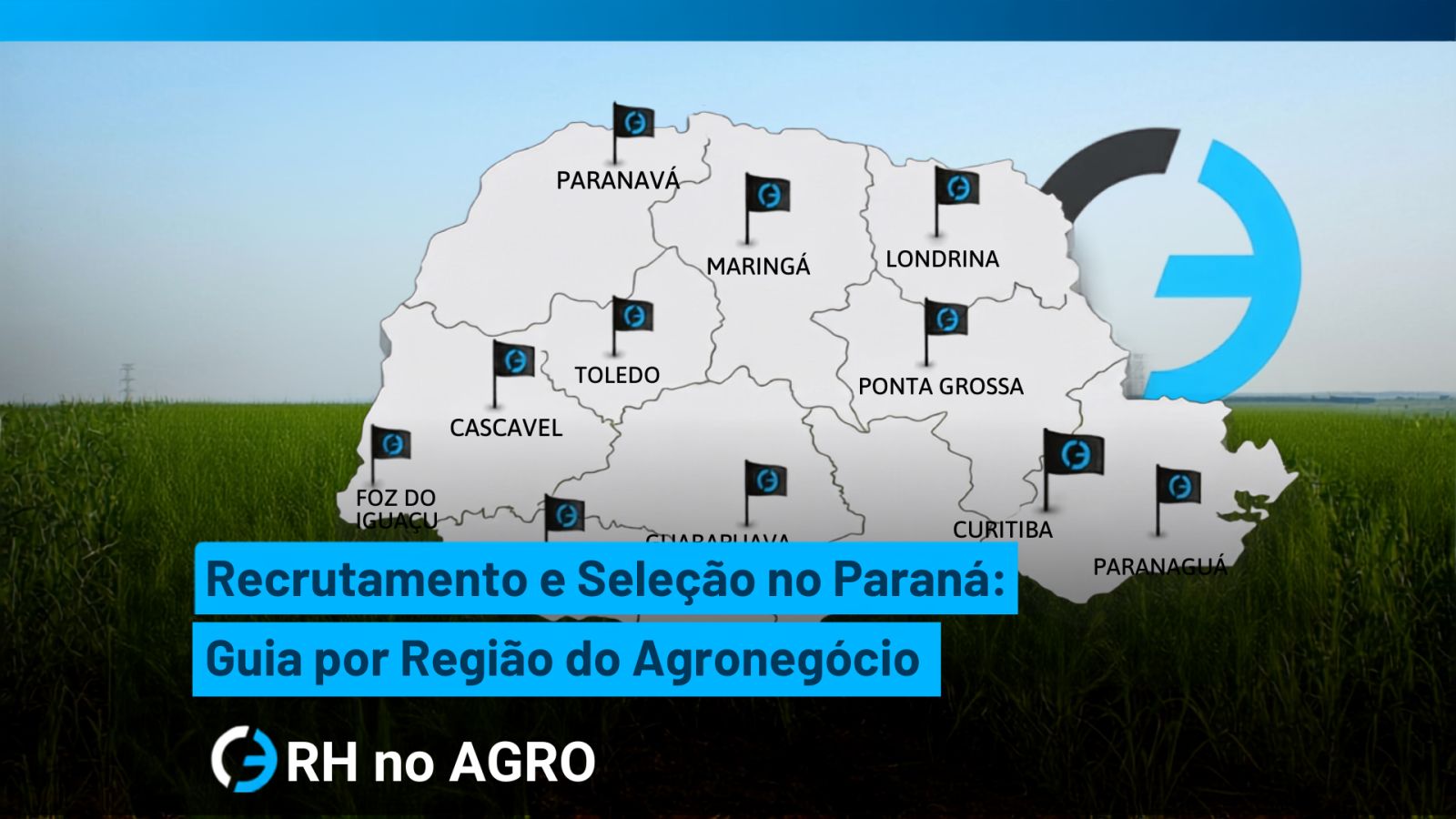
Recruitment and selection in Paraná, in southern Brazil, cannot be treated as a single process for the whole state. Paraná brings together, in an area much more compact than Mato Grosso, a diversity of agricultural vocations rarely found in a single territory: industrial-scale grains in the west, the historic birthplace of coffee in the north, and the highest dairy productivity in the country in the Campos Gerais. Recruiting an executive or a technical specialist for this state without understanding these differences means treating Cascavel, Londrina and Castro as if they were interchangeable, when in practice each one requires a different kind of professional.
This is the kind of nuance that separates a generic selection process from true executive recruitment: understanding the real economy of each region before going out to look for resumes.
Why Paraná concentrates so much strategic agribusiness talent
The answer lies in the combination of fertile soil, strong cooperatives and decades of productive diversification. Paraná does not depend on a single crop: it is a powerhouse in grains, a world reference in agricultural cooperatives and the national leader in dairy productivity, all within the same state. For executive recruitment, this means that strategic positions with very different profiles, grain sales, dairy genetics, cooperative management, exist side by side, each with its own technical yardstick.
Looking at the state as a whole, this complexity can be organized into four major economic clusters, each with its own dominant vocation. This division is not official, but it is the most useful way to see Paraná from a recruiter's point of view.
Cascavel is the showcase of agribusiness in western Paraná
Cascavel has become a national reference in agricultural production, with soybeans, corn and cooperatives generating billions of reais every year. The city hosts Show Rural Coopavel, considered the largest agribusiness fair in Latin America, organized by the Cascavel Agro-Industrial Cooperative since 1989. The event has already generated more than R$ 7 billion in business in a single edition, bringing together more than 600 national and international exhibitors. Recruitment and selection in Paraná in the grain and cooperative segment goes, in practice, through this city.
Companies that make the region a decision-making hub
Coopavel, the cooperative that gives the fair its name, is one of the region's central economic forces, alongside other agro-industrial cooperatives that sustain the grain chain of western Paraná. For executive recruitment, this means a market where cooperative culture weighs as much as technical competence in assessing a candidate.
Toledo is the heart of poultry and pig farming in western Paraná
Toledo is one of the central nodes of Paraná's animal protein chain, surrounded by cooperatives that lead Brazilian poultry and pig farming: Copacol, headquartered in Cafelândia, gets 48.8% of its revenue from poultry and is one of Brazil's largest chicken exporters; Lar Cooperativa, from Medianeira, is among the largest agricultural cooperatives in the country. Together with C.Vale and Copagril, these cooperatives form Frimesa, a union of five Paraná cooperatives working in both pig farming and dairy. Paraná accounts for one third of all chicken production in Brazil, according to the Paraná Department of Agriculture, and much of this production goes through the Toledo-Cafelândia-Medianeira axis. Recruiting there means dealing with a highly specialized technical market in animal nutrition, animal health and the management of integration with partner farmers. Recruitment and selection in Paraná in the animal protein chain almost always means working along this axis.
Palotina is home to C.Vale and one of the largest poultry complexes in Latin America
Palotina, about 60 km from the border with Paraguay, is home to C.Vale, an agro-industrial cooperative that operates one of the largest poultry processing complexes in Latin America, producing frozen chicken and mechanically separated meat for export. Paraná set a historic record in 2022, with more than 2 billion birds produced in the state, more than a third of national production. For recruitment, Palotina represents an industrial and agro-industrial labor market of very large scale, concentrated in a single dominant cooperative, which requires recruiters to deeply understand C.Vale's specific organizational culture before approaching any candidate in the region. Recruitment and selection in Paraná for industrial animal protein positions usually starts right here.
Londrina is the birthplace of terra roxa and the coffee cycle
The predominant soil in northern Paraná is terra roxa, a reddish, fertile soil formed by basalt flows, the same geological formation that supports the terra roxa of the interior of São Paulo. It was this soil that drove the coffee cycle in Londrina and Maringá: in 1961, the region alone accounted for 51% of all the coffee consumed on the planet, according to a report by Revista Oeste. A series of historic frosts in the 1960s and 1970s pushed the region toward diversification, and today Londrina combines grain agribusiness with a relevant agricultural research hub, home to IDR-Paraná. Recruitment and selection in Paraná in agricultural research has in Londrina one of its main hubs.
IDR-Paraná: more than 50 years of science applied to farming
IDR-Paraná, formerly Iapar, was created in Londrina on June 29, 1972 and is today one of Brazil's leading agricultural research institutes, with more than 600 books and technical bulletins published over five decades, according to the Government of the State of Paraná. One of the institute's best-known achievements is the Purunã, the first beef cattle breed developed by a state research center in Brazil. This kind of scientific presence changes the profile of candidates available in the region: every year Londrina trains agronomists and researchers with technical expertise rarely found outside a hub with this tradition.
Maringá is an agribusiness hub and the largest wholesale center in southern Brazil
Maringá divides its economic strength between commerce, technology, the food industry and agribusiness, and it was the city that opened the most agribusiness companies among Paraná's large municipalities in recent years. The city hosts Expoingá, one of the state's main agricultural, industrial and commercial fairs, and Cocamar is one of its most relevant agro-industrial cooperatives. Recruitment and selection in Paraná for agribusiness sales and retail positions finds a mature market in Maringá.
Campo Mourão is synonymous with cooperatives on a continental scale
Campo Mourão is home to Coamo Agroindustrial Cooperativa, founded in 1970 by 79 farmers and today considered one of the largest agricultural cooperatives in Latin America, working in soybeans, corn and wheat in Paraná, Santa Catarina and Mato Grosso do Sul. Recruiting for management positions in Campo Mourão requires understanding cooperative logic: decisions that balance member governance with the efficiency of a large-scale industrial operation. Recruitment and selection in Paraná in the cooperative world necessarily goes through Campo Mourão's culture.
Castro is Brazil's National Dairy Capital
In 2017 Castro received, by federal law, the title of National Dairy Capital, after data from IBGE, Brazil's statistics institute, confirmed the municipality as the country's largest milk producer, a position it has held since 2018. Average yield per cow in Castro exceeds 8,400 liters a year, almost four times the national average of 2,200 liters, a level that rivals the United States and Germany, according to a report by Gazeta do Povo. This result has its roots in the Dutch settlement of Castrolanda, founded between 1951 and 1954, which turned the pastures of the Campos Gerais into a world reference in high-tech dairy farming. Recruiting for technical positions in Castro requires real knowledge of dairy genetics, animal nutrition and high-yield management, a world very different from the beef cattle ranching of other states. Recruitment and selection in Paraná in the dairy segment requires close knowledge of Castro's technical reality.
Ponta Grossa is the logistics corridor of the Campos Gerais
Ponta Grossa is considered the main logistics junction of southern Brazil, connecting the Curitiba metropolitan area, the Port of Paranaguá, western Paraná, Santa Catarina and the interior of São Paulo, which makes the Campos Gerais one of the country's largest goods transport corridors, according to Diário dos Campos. In 2025 alone, more than 39,300 trucks from Ponta Grossa carried 1.46 million tonnes of products to the Port of Paranaguá, and the city alone accounted for 2.2 million of the 6.5 million tonnes of soybean meal exported by the state. The city is also discussing the installation of a dry port, a customs station that would work as an inland extension of the seaport. For recruitment, Ponta Grossa concentrates logistics, foreign trade and operations positions that serve the entire shipping chain of Paraná agribusiness, not just local production. Recruitment and selection in Paraná in logistics and foreign trade has its main center in Ponta Grossa.
Guarapuava is Brazil's largest barley producer
Guarapuava sits on the Guarapuava Plateau, Paraná's third plateau, a cold region that occasionally records snow and that, precisely for this reason, became Brazil's largest barley producer, accounting alone for about 30% of national production, according to the Paraná Department of Agriculture. The municipality is considered the richest in Paraná in gross value of agricultural production, according to the Ministry of Agriculture, with a strong presence of soybeans and corn as well. Recruiting in Guarapuava requires understanding a chain that is uncommon in the rest of Brazil, that of winter grains such as barley and wheat, with contracts and commercial relationships directly linked to the national brewing and malting industry. Recruitment and selection in Paraná in the winter grain segment is, to a large extent, synonymous with Guarapuava.
Francisco Beltrão is a reference in family farming on a regional scale
Francisco Beltrão is the main urban hub of southwestern Paraná, a region that stands out from the rest of the state for its economic base: about 62,000 farms are spread across the region's 42 municipalities, and 85% of them are family farms, according to a survey by Gazeta do Povo. Production ranges from grains to dairy and fruit growing, supported by a system of family farming cooperatives that emerged in the early 2000s and today brings together 17 cooperatives and about 2,000 members. For executive recruitment, the southwest represents a labor market that is structurally different from the rest of Paraná: fewer large-scale operations, more management of networks of small farmers and rural extension programs, a professional profile that rarely appears in the grain hubs of the west or north of the state. Recruitment and selection in Paraná focused on family farming finds in Francisco Beltrão its clearest reference.
Fairs and events that drive agribusiness in Paraná
As in São Paulo and Mato Grosso, each hub in Paraná has an annual event that works as a barometer of the local economy and brings together the sector's main decision-makers, and it often anticipates hiring trends before they appear in published job openings.
What changes in executive recruitment for these regions
The difference between a generic selection process and true executive recruitment lies precisely in this level of regional detail. A grain sales manager for Cascavel needs to understand the logic of cooperatives and industrial scale. A technical specialist for Castro needs to master dairy genetics and nutrition, a world that has nothing to do with beef cattle ranching. A manager for Campo Mourão needs to know how to navigate cooperative governance. A logistics manager for Ponta Grossa needs to understand the entire shipping chain to the Port of Paranaguá. Ignoring these differences and treating Paraná as a single market is the most common recipe for a selection process that takes months and still delivers the wrong candidate.
This variation also shows up in the structure of companies. Along the Toledo–Palotina axis, the market is dominated by a few giant cooperatives, which requires recruiters to deeply understand each one's organizational culture before approaching a candidate. In the southwest, around Francisco Beltrão, the reality is the opposite: dozens of smaller cooperatives and family farmers, a more fragmented market that requires a different kind of mapping, less focused on big brands and more on regional relationship networks.
Most common mistakes when recruiting for agribusiness in Paraná
Treating dairy farming and beef cattle ranching as the same thing: a candidate strong in beef cattle management does not automatically have the technical expertise required by Castro's high-yield dairy farming.
Ignoring cooperative culture in the behavioral assessment: management positions at cooperatives such as Coamo and Coopavel require political skill with members, something experience only in privately held companies does not develop.
Not recognizing the state's productive diversification: treating Paraná only as a grain state ignores the strength of dairy, poultry and cooperatives, which shrinks the pool of qualified candidates considered for each position.
Treating the southwest of the state as a smaller copy of the west: Francisco Beltrão and its region have a structurally different labor market, more fragmented among small cooperatives and family farmers, which requires a different recruitment approach.
Conclusion
Recruitment and selection in Paraná is, in practice, a mosaic of regional vocations within a single state: grains and animal protein in the west, historic coffee in the north, logistics in the Campos Gerais and family farming in the southwest, each with its own technical base and business culture. Understanding this mosaic, hub by hub, is what sets apart a firm that truly knows agribusiness from one that simply applies a standard selection process anywhere in the territory.
If your company needs to recruit strategic talent for agribusiness in Paraná, Geração C3 can help. We specialize in recruitment and selection exclusively for Brazilian and Latin American agribusiness.