

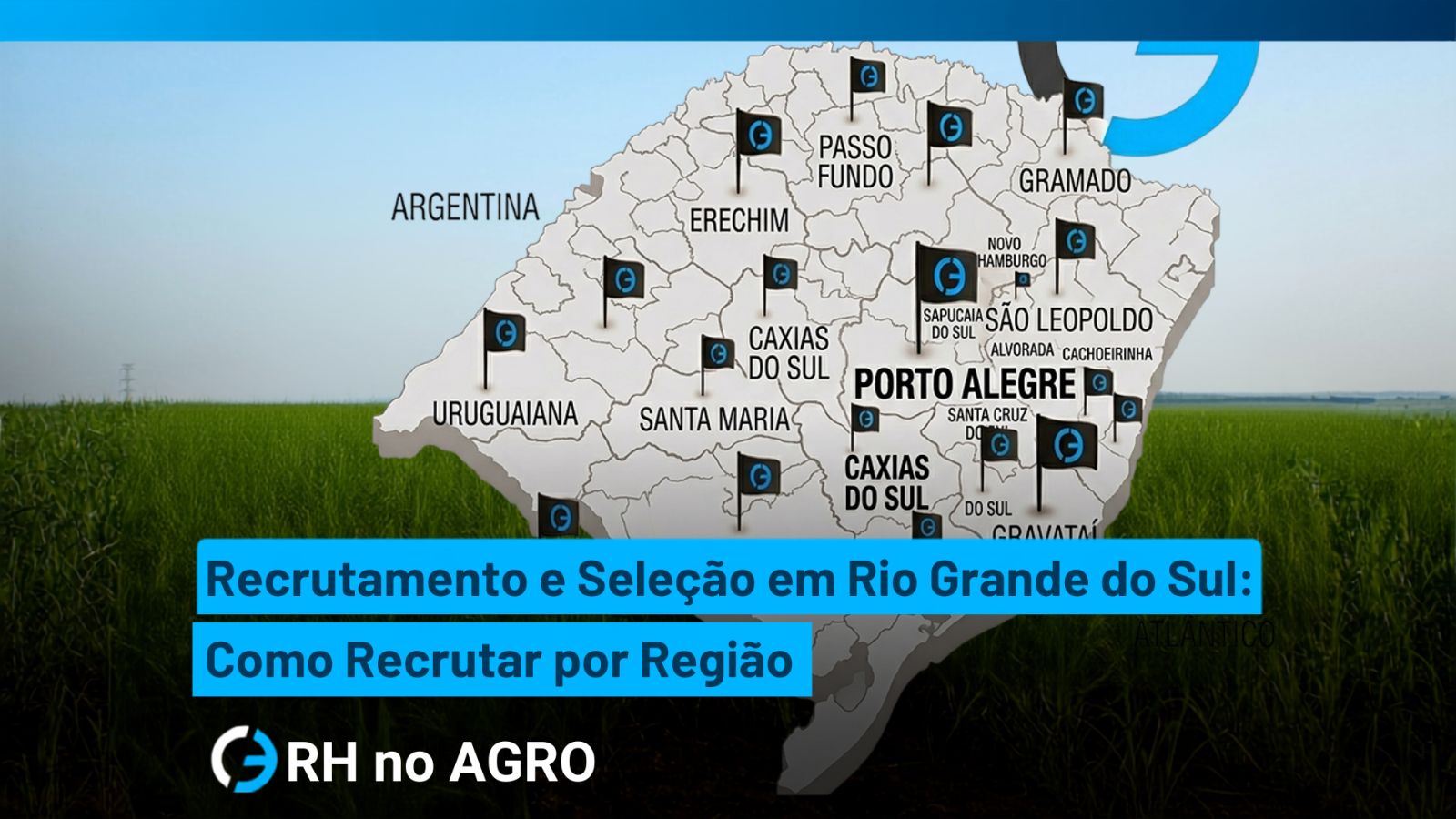
Recruitment and selection in Rio Grande do Sul, Brazil's southernmost state, cannot be treated as a single process for the whole state. Não-Me-Toque is home to the Cotrijal cooperative and to Latin America's largest agricultural machinery manufacturer, Pelotas alone leads Brazil's rice production, and Vacaria accounts for more than 85% of Brazil's apple exports. Recruiting an executive or a technical specialist for this state without understanding these differences means treating the plateau, the border and the coast as if they were interchangeable, when each region requires a different kind of professional.
This is the kind of nuance that separates a generic selection process from true executive recruitment: understanding the real economy of each hub before going out to look for resumes.
Looking at the state as a whole, this complexity can be organized into four major economic clusters, each with its own dominant vocation. This division is not official, but it is the most useful way to see Rio Grande do Sul from a recruiter's point of view.
Não-Me-Toque is home to Cotrijal and to Latin America's largest agricultural machinery manufacturer
Não-Me-Toque concentrates two rare assets in a single municipality: the Cotrijal cooperative, one of the most traditional on the plateau, and the headquarters of Stara, the largest Brazilian manufacturer of agricultural machinery and implements in Latin America, with plants also in Carazinho and Santa Rosa and a production capacity of 9,000 machines a year. The town also hosts Expodireto Cotrijal, held for more than 25 years and established among the largest agribusiness trade fairs in Latin America, bringing together representatives from more than 80 countries and up to 300,000 expected visitors per edition. Recruitment and selection in Rio Grande do Sul in the machinery and cooperative segment goes, in practice, through this town.
Passo Fundo is the state's largest grain exporter
Passo Fundo leads the northern macro-region of Rio Grande do Sul, responsible for 18.7% of the state's GDP, and closed the first half of 2026 as the state's top exporter in 13 product groups, including leadership in wheat, with US$ 85.2 million exported, and in corn, with US$ 57.9 million, according to data from the Passo Fundo City Hall. Recruitment and selection in Rio Grande do Sul in the grain export chain almost always means working along this axis.
Cruz Alta is a historic hub for wheat and soybean research
Cruz Alta hosts Fenatrigo, the National Wheat Fair, organized in partnership with the City Hall, the Rural Union and the University of Cruz Alta (Unicruz), an event now in its 18th edition after 50 years of history linked to wheat growing in the region. The town is also the historic base of agricultural research institutions such as Fundacep, responsible for wheat cultivars now recommended throughout the state. Cruz Alta remains one of the most traditional agricultural research hubs on the plateau.
Santa Rosa is the national birthplace of soybeans and a metal-mechanical hub
Santa Rosa is known as the national birthplace of soybeans and has the largest dairy basin in Rio Grande do Sul, but its current economy revolves around a metal-mechanical hub focused on agriculture that brings together global manufacturers such as AGCO and John Deere, as well as a Stara plant, according to the Santa Rosa City Hall. The three activities that employ the most people in the town are agricultural machinery manufacturing, public administration and pig slaughtering, a combination that requires recruiters to move between industrial and agricultural profiles in the same location.
Ijuí is the historic home of Cotrijuí
Ijuí is one of the most traditional cooperative centers in the northwest of the state, home to Cotrijuí, founded in 1957 and today with more than 19,200 members working in the processing, industrialization and marketing of agricultural products at sites spread across the state's northwest, the western border and the Campanha region. Recruiting for management positions in Ijuí requires understanding cooperative logic: member governance weighs as much as technical competence in assessing a candidate.
Vacaria is Brazil's apple capital
Vacaria accounts for more than 230,000 of the roughly 460,000 tonnes of apples produced each year in Rio Grande do Sul, which in turn concentrates 47% of Brazil's entire production of the fruit, and it accounts for more than 85% of Brazil's apple exports, to destinations such as India, Portugal, the United Arab Emirates and the United Kingdom, according to Jornal do Comércio. In the temperate fruit segment, Vacaria is, to a large extent, synonymous with the entire market.
Uruguaiana is a reference in cattle and rice on the western border
Uruguaiana is one of the central municipalities of the region known as the Western Border (Fronteira Oeste), alongside Itaqui and São Borja, with strong productivity in rice, soybean and corn crops and strategic warehouses for shipping production, according to data from CNA Brasil. Proximity to Argentina adds a dynamic of binational trade that is uncommon in the rest of the state. Recruiting for Uruguaiana requires knowledge of irrigated rice farming and border trade, a profile that is rare outside this region.
Bagé is a cattle ranching reference in the Campanha region
Bagé lies at the heart of the Southern Campanha, a region historically associated with beef cattle ranching and wool production in Rio Grande do Sul, and it is home to Embrapa Pecuária Sul, a research unit dedicated to crop-livestock integration and native grassland management, about 60 km from the border with Uruguay. Recruiting for technical roles in extensive beef cattle ranching in Bagé requires real knowledge of native grassland management and crop-livestock integration, the raw material of business in the region.
Pelotas is Brazil's largest rice producer
Pelotas leads rice production among all Brazilian municipalities, with more than 500,000 tonnes per harvest, about 100,000 hectares cultivated, more than 1,500 farms involved and more than 25 storage facilities in the region, within a state that alone accounts for about 70% of Brazil's entire production of the grain. Recruitment and selection in Rio Grande do Sul in the rice segment has its strongest national reference in Pelotas, a market that requires specific technical knowledge of lowland irrigation and rice processing.
Rio Grande is the port that ships the state's agribusiness to the world
The Port of Rio Grande handles more than 90% of all products made in Rio Grande do Sul for export, having moved about 25.9 million tonnes in 2023, the 5th largest volume among Brazilian ports, with soybeans accounting for more than 30% of the total weight handled, according to data compiled by Embrapa. Its strategic location, close to Mercosur, earned the complex the nickname "Port of Mercosur". Recruitment and selection in Rio Grande do Sul in foreign trade and port logistics has its main center in Rio Grande.
Fairs and events that drive agribusiness in Rio Grande do Sul
As in São Paulo, Mato Grosso, Paraná and Goiás, each hub in Rio Grande do Sul has an annual event that works as a barometer of the local economy and brings together the sector's main decision-makers, a good indicator of where demand for talent intensifies each year.
What changes in executive recruitment for these regions
The selection process in Rio Grande do Sul's agribusiness changes its technical and cultural nature with each hub visited, from the strong accent of the plateau to the negotiating style of the border. The difference between a generic selection process and true executive recruitment lies precisely in this level of regional detail. A grain sales manager for Passo Fundo needs to understand large-scale exports. A technical specialist for Bagé needs to master native grassland management and extensive cattle ranching, a world apart from the rice farming of Pelotas. A logistics executive in Rio Grande needs to understand Mercosur's entire port chain. Ignoring these differences and treating Rio Grande do Sul as a single market is the most common recipe for a selection process that takes months and still delivers the wrong candidate.
This variation also shows up in the structure of companies. Along the Não-Me-Toque, Passo Fundo and Ijuí axis, the market is shaped by century-old cooperatives with a strong regional identity, which requires recruiters to understand each one's own culture before approaching a candidate. On the western border and in the Campanha, the reality is more dispersed, with family cattle and rice farms spread over a vast territory, a market that requires more patient mapping and less focus on big corporate brands.
Most common mistakes when recruiting for agribusiness in Rio Grande do Sul
Treating Rio Grande do Sul as a single, homogeneous market: it ignores that the cultural distance between the plateau and the border is as great as between different states, with their own economies and regional accents.
Ignoring the plateau's cooperative culture in the behavioral assessment: management positions at cooperatives such as Cotrijal and Cotrijuí require political skill with members, something experience in private companies alone does not develop.
Not distinguishing the grain, rice and cattle chains in the technical interview: a candidate strong in soybeans is not automatically qualified for irrigated rice farming or native grassland management.
Underestimating Rio Grande's logistics role in the entire state's chain: treating the city as irrelevant to agribusiness just because it does not produce grain ignores its strategic role in shipping more than 90% of the state's exports.
Conclusion
Recruitment and selection in Rio Grande do Sul is, in practice, a mosaic of regional markets within a single state: grains and machinery on the plateau, apples in the highlands, cattle and rice on the border and in the Campanha, port logistics on the coast, each with its own technical base and business culture. Understanding this mosaic, hub by hub, is what sets apart a firm that truly knows agribusiness from one that simply applies a standard selection process anywhere in the territory.
If your company needs to recruit strategic talent for agribusiness in Rio Grande do Sul, Geração C3 can help. We specialize in recruitment and selection exclusively for Brazilian and Latin American agribusiness.