

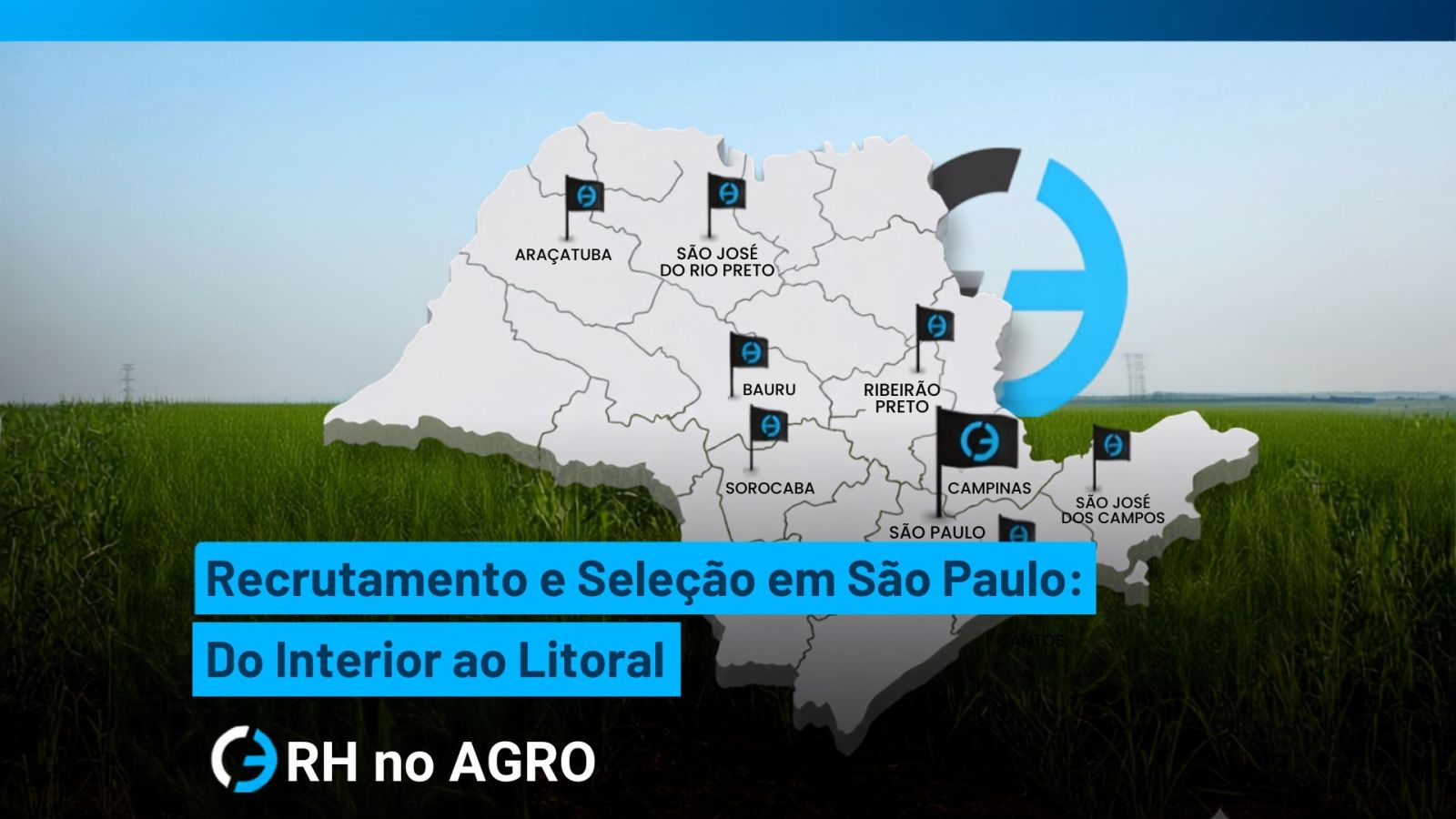
Recruitment and selection in the state of São Paulo, when it comes to agribusiness, cannot be treated as a single, generic process for the whole state. The interior of São Paulo concentrates, in a relatively compact strip of territory, some of the most strategic hubs of Brazilian agribusiness: the country's largest decision-making center for sugar and ethanol, the national reference in cattle genetics, Latin America's largest industrial cluster of sugarcane machinery and research centers that shaped the agriculture Brazil practices today. Recruiting an executive or a technical specialist for this region without understanding these differences means treating Ribeirão Preto, Barretos and Sertãozinho as if they were interchangeable, when in practice each one requires a different kind of professional.
This is the kind of nuance that separates a generic selection process from true executive recruitment: understanding the real economy of the region before going out to look for resumes.
Why the interior of São Paulo concentrates so much strategic agribusiness talent
The answer lies in the combination of fertile soil, industrial tradition and decades of investment in agricultural research concentrated in the same region. It is no accident that national companies chose to set up headquarters and production units there, or that research institutions such as Esalq and Embrapa established themselves precisely along this axis of the state. For executive recruitment, this means that a large share of the most strategic positions in Brazilian agribusiness, in senior management, operations, sales and R&D, is concentrated in a specific geographic area, with its own business culture that a recruiter from outside the sector rarely recognizes at first.
Looking at the state as a whole, this complexity can be organized into four major economic clusters, each with its own dominant vocation. This division is neither official nor strictly geographic, but it is the most useful way to see the state from a recruiter's point of view: each cluster concentrates a different type of company, candidate and labor market dynamic.
Ribeirão Preto is Brazil's agribusiness capital
Ribeirão Preto holds the title of Brazil's agribusiness capital, and it is no coincidence that the city hosts Agrishow every year, the largest agricultural technology fair in Latin America. The latest edition brought together more than 800 exhibiting brands and about 197,000 qualified visitors, and generated R$ 14.6 billion in business, according to data from Agrishow itself. For anyone recruiting in the region, this event alone says a lot about the kind of decisions made there: technology, scale and high-volume negotiation.
Terra roxa soil and what it supports
The predominant soil in the Ribeirão Preto and Franca region is terra roxa, technically a red latosol, formed by the decomposition of basaltic rock over millions of years and known for its exceptional fertility, as explained by Canal Rural. It was this soil that supported the expansion of coffee growing in the region in the late 19th century, and it is what supports today the sugarcane, soybeans, corn and oranges that make the region one of the most productive agricultural axes in the country. Understanding this technical base helps recruiters ask better questions in interviews: a candidate who has worked with soil management on terra roxa brings different practical experience from someone who only knows sandy or Cerrado soils.
Companies that make the region a decision-making hub
Grupo São Martinho, one of Brazil's largest sugar and ethanol groups, is headquartered in Pradópolis, in the Ribeirão Preto metropolitan area, with a crushing capacity of about 24 million tonnes of sugarcane a year. Companies such as Raízen and Copersucar also maintain a strong operational and commercial presence in the region, forming an ecosystem of trading companies, mills and suppliers that concentrates strategic decisions on purchasing, origination and marketing. For executive recruitment, this means a dense, competitive labor market with high turnover of talent between competing companies, the kind of scenario where a confidential, well-mapped approach makes all the difference. Recruitment and selection in São Paulo in the sugar and ethanol segment goes, in practice, through this city.
Barretos means elite cattle ranching and the genetics that defined Brazil
Barretos is recognized as Brazil's cattle capital, a city whose economic and cultural identity revolves around cattle ranching. The city hosts the Barretos Rodeo Festival, the largest rodeo in the southern hemisphere, which draws about one million people each edition, according to widely documented data about the event. But behind the festival lies a serious and sophisticated cattle industry.
Nelore, Gir and zebu culture
The region has a strong presence of the zebu breeds Nelore and Gir, and maintains historical ties with the Brazilian Association of Zebu Breeders (ABCZ), the national reference organization in cattle genetics. Nelore, heat-resistant and adapted to Brazil's tropical climate, is today the most numerous beef breed in the country, and much of the technical knowledge about zebu genetic improvement practiced in Brazil has its roots in this region. Recruiting for technical and commercial roles linked to cattle ranching in Barretos requires understanding this world: conducting a technical interview without knowledge of body condition scoring, assisted reproduction or zebu genetics means losing credibility with the candidate before even talking about the position. Recruitment and selection in São Paulo in the elite cattle segment is, to a large extent, synonymous with Barretos.
Sertãozinho is the capital of sugarcane equipment
Sertãozinho, next to Ribeirão Preto, is Latin America's largest industrial cluster of machinery and equipment for the sugar and ethanol sector, a true cluster of metalworking companies and manufacturers of boilers, mills and components that supply mills throughout Brazil and other sugarcane-producing countries. The magazine Pesquisa Fapesp has described the city as a true innovation hub for the sector. The Santaelisa Vale mill, one of the country's largest ethanol producers, is also headquartered in the region. For recruitment, Sertãozinho represents a labor market that blends agribusiness and heavy industry: mechanical, production and industrial maintenance engineers are sought after by both agribusiness and the traditional metalworking industry. Recruitment and selection in São Paulo in the sugarcane machinery chain almost always means working along this axis.
Piracicaba is a reference in science, Esalq and the sugar and ethanol tradition
Piracicaba has a feature that no other city in the region reproduces in the same way: it is home to the Luiz de Queiroz College of Agriculture, Esalq, one of the most respected agronomy schools in the country and part of the University of São Paulo (USP). This makes Piracicaba a hub of top-level technical education, producing many of the agronomists, agricultural engineers and researchers who later spread across the entire productive sector of the interior of São Paulo. The city also has its own sugar and ethanol tradition, with mills in the Limeira and Américo Brasiliense regions forming part of the same economic belt as Ribeirão Preto. Recruiting in Piracicaba usually means access to candidates with cutting-edge technical training, often still early in their careers, fertile ground for trainee programs and junior talent development in agribusiness. Recruitment and selection in São Paulo in the scientific field has in Piracicaba one of its main hubs.
São Carlos is where research created a genuinely Brazilian cattle breed
São Carlos holds a little-known but technically fascinating chapter of Brazilian cattle ranching: it was there, at what is now Embrapa Pecuária Sudeste, that researchers developed the Canchim, a genuinely Brazilian synthetic cattle breed made up of five-eighths Charolais blood and three-eighths zebu blood, as documented by Embrapa itself. The goal was to combine the early maturity and meat quality of the European Charolais with the hardiness of the zebu, adapted to the tropical climate. It is a rare example of how applied public research generated its own genetic asset for national cattle ranching, and it reinforces the role of São Carlos as a scientific hub of agribusiness in São Paulo, alongside Piracicaba. Recruitment and selection in São Paulo focused on public research finds in São Carlos a rare technical reference.
Campinas is the birthplace of agricultural research in São Paulo
Campinas does not always come up in conversations about agribusiness, but it is home to one of the oldest and most influential institutes of Brazilian agricultural research: the Agronomic Institute (IAC), founded in 1887 by Emperor Dom Pedro II as the Campinas Agronomic Station, a pioneer of agricultural research in the country. Today the IAC brings together more than 160 research scientists across 12 research centers, including units in Ribeirão Preto, Jundiaí, Cordeirópolis and Votuporanga, according to the Agronomic Institute itself. The city also hosts Embrapa units focused on digital and territorial agriculture, in partnership with Unicamp. For recruitment, this puts Campinas in a peculiar position: it is not a production hub in the direct agricultural sense, but it is a center of technical and scientific intelligence that trains many of the researchers and specialists who later work in the rest of the state, and it concentrates logistics operations and regional headquarters of companies serving the entire interior. Recruitment and selection in São Paulo in research and science has in Campinas one of its most relevant centers.
Sorocaba is the legacy of the tropeiros and a new agro-industry hub
Few cities in the state have such an old relationship with Brazilian cattle ranching as Sorocaba. From 1733, the city became the main junction of Brazil's tropeiro trade, the cattle and mule drovers: the Viamão Trail, a route of more than 1,500 kilometers from Rio Grande do Sul, brought herds of cattle and mule trains to Sorocaba, where the animals were fattened, traded and redistributed to the mining regions of Minas Gerais. Every year from 1750, the city hosted the famous Mule Fair (Feira de Muares), which lasted two full months and ran until 1897. This historical legacy helps explain why Sorocaba developed, centuries later, a strong ecosystem of logistics, agricultural trade and the input and equipment industry for agribusiness, now combined with a diversified economy that attracts technology and service companies. For recruiters, this means access to a labor market that combines traditional know-how in cattle ranching with a modern industrial base, a candidate profile that can move between both worlds. Recruitment and selection in São Paulo along the logistics and industrial axis necessarily goes through Sorocaba's culture.
São José dos Campos is the former dairy basin of the Paraíba Valley
From 1920, families from Minas Gerais migrated to the São Paulo part of the Paraíba Valley and converted old coffee farms into dairy farms, which became the economic base of the entire region. Over the following decades, São José dos Campos established itself as the state's main milk producer, alternating the lead with neighboring Guaratinguetá: census data show the evolution, from 5,450 head of cattle in 1912 to almost 47,000 in 1970, according to a survey by the São Paulo Institute of Agricultural Economics (IEA). Today the city is better known for its aerospace and technology industry, but this dairy heritage remains present in the metropolitan area and in the Paraíba Valley as a whole. For executive recruitment, the Valley represents a mixed labor market, where professionals in dairy farming, dairy processing and cooperatives coexist with a highly complex industrial and technology hub, which requires recruiters to move between two very different candidate profiles. Recruitment and selection in São Paulo in the dairy segment requires close knowledge of the technical reality of São José dos Campos.
Santos is the gateway of São Paulo agribusiness to the world
No discussion of recruitment in São Paulo agribusiness is complete without Santos, even though the city does not produce a single tonne of soybeans or sugarcane. The Port of Santos is the largest port complex in Latin America and, in 2024, handled 179.8 million tonnes, the best annual result in its history, according to Canal Rural. It is the world's largest export port for sugar, orange juice and green coffee, and also the world's largest soybean exporter, with 27.8 million tonnes of soybeans and 27 million tonnes of sugar shipped in a single year. This concentration of logistics and commercial operations makes Santos a very specific recruitment hub: port operations managers, foreign trade specialists, trading companies and international logistics, profiles rarely found in the producing cities of the interior but essential for the agricultural production of the rest of the state to actually reach the international market. Recruitment and selection in São Paulo in foreign trade and port logistics has its main center in Santos.
Bauru is the junction that connects agribusiness in western São Paulo
Bauru grew around an asset that today is more history than operation: the Bauru Railway Complex, considered the largest railway junction in South America, the meeting point of three major railways that drove the shipment of agricultural production from the interior of São Paulo from the early 20th century, as documented by Condephaat, the state of São Paulo's historical heritage protection agency. This role as a logistics junction shaped the city's economic vocation, today a regional center for distribution, agricultural trade and services serving the entire western region of the state. A few kilometers away is Bastos, known as Brazil's egg capital, responsible for about 35% of egg production in the state of São Paulo, reinforcing the region's vocation in poultry and food distribution logistics. For recruitment, Bauru is often the regional base of companies that serve a wide radius of smaller municipalities, requiring professionals with a commercial and operational profile used to managing extensive territories. Recruitment and selection in western São Paulo often goes through Bauru's logistics base.
São José do Rio Preto is the agricultural hub of northwestern São Paulo
São José do Rio Preto leads a region whose economy combines agricultural production with integrated industrial activity: sugarcane, beef cattle and citrus in the countryside, plus food processing, biofuel and other industrial segments in the city, according to the state government's Map of the São Paulo Economy. The region is also the state's largest latex producer, which encouraged the establishment of a natural rubber production chain that is uncommon in other parts of the country. The most visible symbol of this vocation is Expo Rio Preto, the region's traditional agricultural fair, now in its 63rd edition. For executive recruitment, Rio Preto works as a kind of regional capital: it concentrates the headquarters of companies serving dozens of smaller municipalities in northwestern São Paulo, with a business culture that mixes rural tradition and urban sophistication. Recruitment and selection in northwestern São Paulo finds in Rio Preto its main regional reference.
Araçatuba is Brazil's fat cattle capital
For more than 60 years, Araçatuba has held the title of Brazil's "fat cattle" (boi gordo) capital. This vocation was born in the 1960s, when cattle ranchers from Minas Gerais, Mato Grosso and Goiás realized that animals lost significant weight while being driven and began using pastures in the region to rest and fatten them before continuing their journey. Over time, this strategic stop turned Araçatuba into the country's main cattle production hub, to the point that local ranchers directly influenced the formation of cattle prices on the national market, according to a report by Correio Braziliense. Today the city brings together meatpacking plants, cattle genetics laboratories and livestock marketing centers serving all of Brazil, while maintaining a relevant presence in sugarcane and bioenergy. Recruiting for Araçatuba means dealing with a labor market of extremely high technical specialization in beef cattle, where real knowledge of feedlots, animal nutrition and zebu genetics counts more than a diploma. Recruitment and selection in São Paulo in the beef cattle segment is, to a large extent, synonymous with Araçatuba.
Fairs and events that drive agribusiness in São Paulo
In addition to the companies based there, each hub in the state has an annual event that works as a barometer of the local economy, brings together the sector's decision-makers and is usually a good indicator of where demand for talent is heading. Knowing this calendar helps both recruiters and those mapping career opportunities in the region, because it is precisely at these events that much of the commercial negotiation and behind-the-scenes conversations about hiring actually take place.
What changes in executive recruitment for these regions
The difference between a generic selection process and true executive recruitment lies precisely in this level of regional detail. A sales director for a mill in Ribeirão Preto needs to understand trading dynamics and sugarcane origination. A technical manager for a genetics company in Barretos or Araçatuba needs real knowledge of zebu breeding. A production engineer for Sertãozinho moves between the vocabulary of agribusiness and that of the heavy metalworking industry. A port operations manager in Santos deals with foreign trade rules that do not exist in any city of the interior. Ignoring these differences and treating the whole state as a single, homogeneous market is the most common recipe for a selection process that takes months and still delivers the wrong candidate.
According to a survey by Forbes, compensation for executive positions in Brazilian agribusiness varies enormously depending on the complexity of the role and the region, reinforcing that comparing senior management positions between hubs as different as Ribeirão Preto and Araçatuba, without adjusting for the local reality, is a recurring mistake made by recruiters from outside the sector.
This variation also shows up in the speed of the process. In more concentrated clusters, such as the Ribeirão Preto–Sertãozinho axis, the pool of qualified candidates is small and contested, which requires a direct, confidential approach from the very first contact, or the target candidate may hear about the position from a competitor before the consulting firm even reaches out. In more dispersed hubs, such as western São Paulo, the challenge is usually different: finding candidates willing to move to smaller towns, which requires a well-built value proposition around quality of life, lower cost of living and proximity to family, arguments that rarely appear spontaneously in a generic job description.
Most common mistakes when recruiting for agribusiness in the interior of São Paulo
Treating candidates from outside the region as equivalent to those already working there: this ignores that a local network of relationships, with suppliers, cooperatives and other companies in the same hub, is part of the value an experienced professional from the region brings.
Underestimating competition for talent between companies in the same cluster: especially in Ribeirão Preto and Sertãozinho, where mills and equipment manufacturers actively compete for the same limited pool of experienced engineers and managers.
Not adapting the technical language of the interview to the city's vocation: any experienced candidate notices quickly, and it silently signals that the selection process does not truly understand the sector.
Ignoring the logistics and science hubs that do not produce but sustain the chain: treating Campinas, Santos or Bauru as irrelevant to agribusiness just because they have no crops or pastures ignores equally strategic roles in research, exports and distribution.
Conclusion
Recruitment and selection in São Paulo, when it comes to agribusiness, is in practice a mosaic of distinct regional markets, each with its own economic vocation, technical base and business culture, from the sugar and ethanol industry of Ribeirão Preto to the cattle ranching of Araçatuba, through the science of Campinas and the port of Santos. Understanding this mosaic, city by city, is what sets apart a firm that truly knows agribusiness from one that simply applies a standard selection process anywhere in the state.
If your company needs to recruit strategic talent for the interior of São Paulo, Geração C3 can help. We specialize in recruitment and selection exclusively for Brazilian and Latin American agribusiness.