

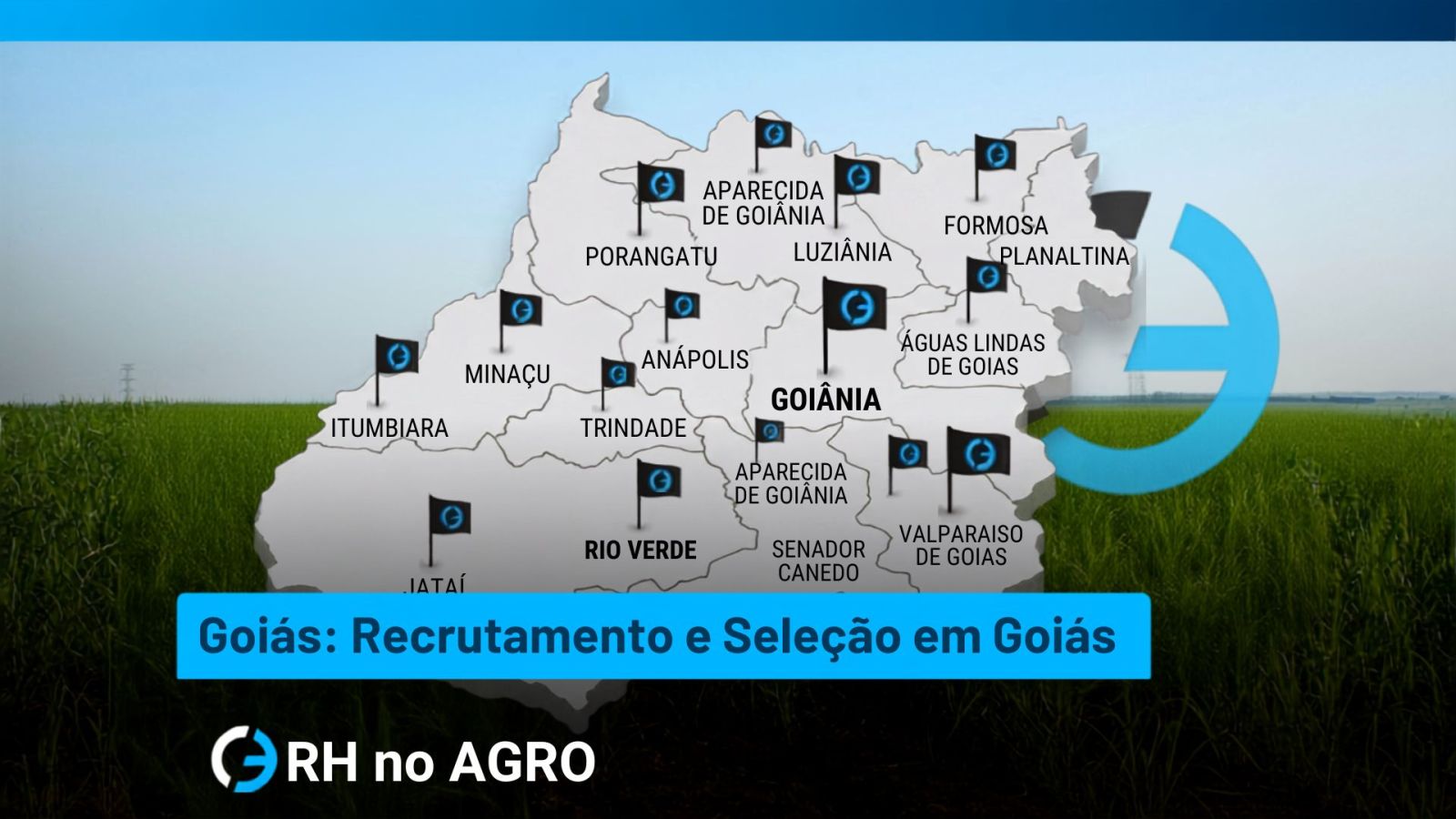
Recruitment and selection in Goiás, in Brazil's Center-West, cannot be treated as a single process for the whole state. Rio Verde alone tripled its GDP in a decade and accounts for 30% of everything Goiás exports, while Cristalina has Brazil's largest irrigated area, about 80,000 hectares, and Goiânia works as the institutional capital of a cooperative system whose assets already equal 20% of the state's GDP. Recruiting an executive or a technical specialist for this state without understanding these differences means treating Rio Verde, Anápolis and Goiânia as if they were interchangeable, when each one requires a different kind of professional.
This is the kind of nuance that separates a generic selection process from true executive recruitment: understanding the real economy of each hub before going out to look for resumes.
Looking at the state as a whole, this complexity can be organized into four major economic clusters, each with its own dominant vocation. This division is not official, but it is the most useful way to see Goiás from a recruiter's point of view.
Rio Verde is the agribusiness capital of Goiás
Rio Verde is today the largest soybean producer in the state of Goiás and ranks among Brazil's 15 largest agricultural municipalities, having harvested 1.5 million tonnes of soybeans and 2.5 million tonnes of corn in 2022, according to the Rio Verde City Hall. The town tripled its GDP in a decade and alone accounts for 30% of everything Goiás exports, according to a report by Revista Oeste. Recruitment and selection in Goiás in the grain segment goes, in practice, through this town.
Comigo and BRF's largest plant in Brazil
The Mixed Cooperative of Rural Producers of Southwest Goiás (Comigo), founded in 1975, does not just trade grain: it runs health units, agricultural schools, input stores, silos and research laboratories, an operating model that makes it one of the most complete cooperatives in Brazil. Rio Verde is also home to BRF's largest plant operating in the country, which makes the town a hybrid hub of grain farming and industrial-scale animal protein. Recruiting for management positions in Rio Verde requires understanding this dual vocation: a grain sales profile is rarely interchangeable with an industrial slaughtering and processing operations profile.
Jataí is a national reference in soybeans and corn
In 2022 Jataí ranked 11th among Brazil's largest soybean producers, with 1.2 million tonnes, up 8.5% on the previous year, and 4th nationally in corn production, with more than 1.6 million tonnes harvested, according to official data cited by the Jataí City Council. The value of the municipality's agricultural production reaches R$ 4.83 billion. Recruitment and selection in Goiás in the large-scale grain chain almost always means working along the Rio Verde-Jataí axis.
Montividiu is a candidate for grain capital per hectare
Montividiu is small in area, only 190,000 hectares of territory, of which 165,000 are productive, but it delivers the best soybean yield per hectare in Brazil, which led the Legislative Assembly of Goiás to discuss recognizing the municipality as the grain capital, according to the Alego Portal. The town is also among the state's five largest soybean exporters, alongside Rio Verde, Jataí, Cristalina and Itumbiara. Recruitment and selection in Goiás in high technical productivity hubs has in Montividiu a rare example of efficiency per planted area.
Mineiros is an industrial hub for cotton, soybeans and sugarcane
Mineiros has two agro-industrial districts managed by Codego, DAIM I and DAIM II, which together cover 1.1 million square meters and house agribusiness, construction and food industry companies. The municipality ranks 36th among the richest in Brazilian agribusiness, with R$ 2.57 billion in production value, and is the state's 5th largest sugarcane producer, according to the Goiás Department of Agriculture. Recruitment and selection in Goiás in the industrial grain and cotton segment often goes through Mineiros's logistics base.
Chapadão do Céu is the cotton capital of Goiás
Chapadão do Céu leads cotton production among municipalities in Goiás, accounting for 39.1% of the state's entire production, and ranks 6th in the state in corn, with 393,000 tonnes harvested, according to the Chapadão do Céu City Hall. The town is also home to the Porto das Águas mill, owned by Grupo Cerradinho, one of the state's largest ethanol producers, which places it among the top four municipalities in Goiás in agricultural GDP. Recruitment and selection in Goiás in the cotton segment is, to a large extent, synonymous with Chapadão do Céu.
Goiânia is the institutional heart of agricultural cooperatives
Goiânia is not a production hub in the direct agricultural sense, but it works as the institutional and financial heart of agribusiness in Goiás. The state's cooperatives hold assets equivalent to about 20% of the state's GDP, and of the 100 largest agribusiness companies in Goiás, 27 are cooperatives, many with administrative headquarters in the capital, according to industry data. Agricultural production in Goiás reached R$ 121.37 billion in gross value in 2025, up 20.4%, employing 1.1 million people across the chain, equivalent to 28.6% of the state's employed population. For executive recruitment, Goiânia concentrates positions in regional management, institutional relations and the management of credit cooperatives such as Sicredi and Sicoob, profiles that are very different from those found in the producing towns.
Anápolis is the logistics junction of agribusiness in Goiás
Anápolis is home to the Anápolis Agro-Industrial District (DAIA), one of the largest industrial districts in the country, opened in 1976, and the Porto Seco Centro-Oeste, a bonded dry port operating since 1999 that speeds up import and export procedures and reduces storage costs, according to WikiGoiás. Its strategic location, 59 km from Goiânia and 149 km from Brasília, earned the town the nickname "Brazil's crossroads". Recruitment and selection in Goiás in logistics and foreign trade has its main center in Anápolis.
Cristalina is the capital of irrigated agriculture
Cristalina has the largest irrigated area in the country, about 80,000 hectares, which allows up to three harvests a year depending on the crop, and today grows about 60 different products, including grains, coffee, potatoes, onions, garlic, tomatoes and beans, according to a report by Canal Rural. The municipality is the state's largest coffee producer and ranks 7th nationally in agricultural production value, with R$ 3.44 billion. Recruitment and selection in Goiás focused on agricultural diversification finds in Cristalina its most complete example, a market that requires technical profiles able to move between very different crops throughout the year.
Quirinópolis is a hub for sugarcane mills and corn ethanol
Quirinópolis is home to two large sugarcane mills: Boa Vista, a joint venture between Grupo São Martinho and Petrobras, with capacity to process about 5 million tonnes of cane per harvest and about 3,600 direct jobs, and São Francisco, owned by the São Paulo group USJ in partnership with Cargill, according to sugar and ethanol industry data compiled by Unicamp. With the arrival of these mills, the municipality's tax revenue quadrupled in ten years, and it is also expanding corn ethanol production. Recruiting for Quirinópolis requires specific technical expertise in sugar and ethanol processing, a world apart from the grain chain of the rest of the state.
Itumbiara is a hub for energy and diversified agro-industry
Itumbiara is home to the Itumbiara Hydroelectric Plant, the largest in the Furnas System, with an installed capacity of 2,082 MW, as well as the Itumbiara Agro-Industrial District (DIAGRI), with more than one million square meters dedicated to agribusiness, construction and food industries, according to data compiled by Furnas. The town stands out as a strong producer of oranges, sugarcane, cotton and soybeans, and has the state's eighth largest dairy herd. Recruitment and selection in Goiás at the intersection of energy and agro-industry finds in Itumbiara its clearest reference.
Fairs and events that drive agribusiness in Goiás
As in São Paulo, Mato Grosso and Paraná, each hub in Goiás has an annual event that works as a barometer of the local economy and brings together the sector's main decision-makers, a good indicator of where demand for talent intensifies each year.
What changes in executive recruitment for these regions
The difference between a generic selection process and true executive recruitment lies precisely in this level of regional detail. A grain sales manager for Rio Verde needs to understand industrial scale and cooperatives. A technical specialist for Chapadão do Céu needs to master the cotton chain, a world apart from grains. An institutional executive in Goiânia needs to understand credit cooperative governance. Ignoring these differences and treating Goiás as a single market is the most common recipe for a selection process that takes months and still delivers the wrong candidate.
This variation also shows up in the speed of the process. Along the Rio Verde–Jataí–Montividiu axis, the pool of qualified candidates is small and contested by cooperatives and multinationals at the same time, which requires a confidential approach from the very first contact. In Anápolis and Goiânia, the main challenge is usually different: finding professionals with institutional and financial expertise, a profile that is rarer than the traditional agronomist.
Most common mistakes when recruiting for agribusiness in Goiás
Treating Goiás as a single, homogeneous market: it ignores that the distance between the vocation of Rio Verde and that of Cristalina is as great as between different states, with their own economies and business cultures.
Ignoring the institutional role of Goiânia and Anápolis: treating these cities as irrelevant to agribusiness just because they do not produce grain ignores their strategic role in cooperatives, logistics and foreign trade.
Not distinguishing the grain, cotton and sugarcane chains in the technical interview: a candidate strong in soybeans is not automatically qualified for cotton or sugar and ethanol processing.
Underestimating how concentrated qualified candidates are in smaller hubs: in towns such as Montividiu or Chapadão do Céu, the limited technical pool requires more careful mapping than in larger hubs such as Rio Verde.
Conclusion
Recruitment and selection in Goiás is, in practice, a mosaic of regional markets within a single state: grains and animal protein in the southwest, cooperatives and logistics in the center, diversified irrigation in the east, energy and sugarcane in the south, each with its own technical base and business culture. Understanding this mosaic, hub by hub, is what sets apart a firm that truly knows agribusiness from one that simply applies a standard selection process anywhere in the territory.
If your company needs to recruit strategic talent for agribusiness in Goiás, Geração C3 can help. We specialize in recruitment and selection exclusively for Brazilian and Latin American agribusiness.