

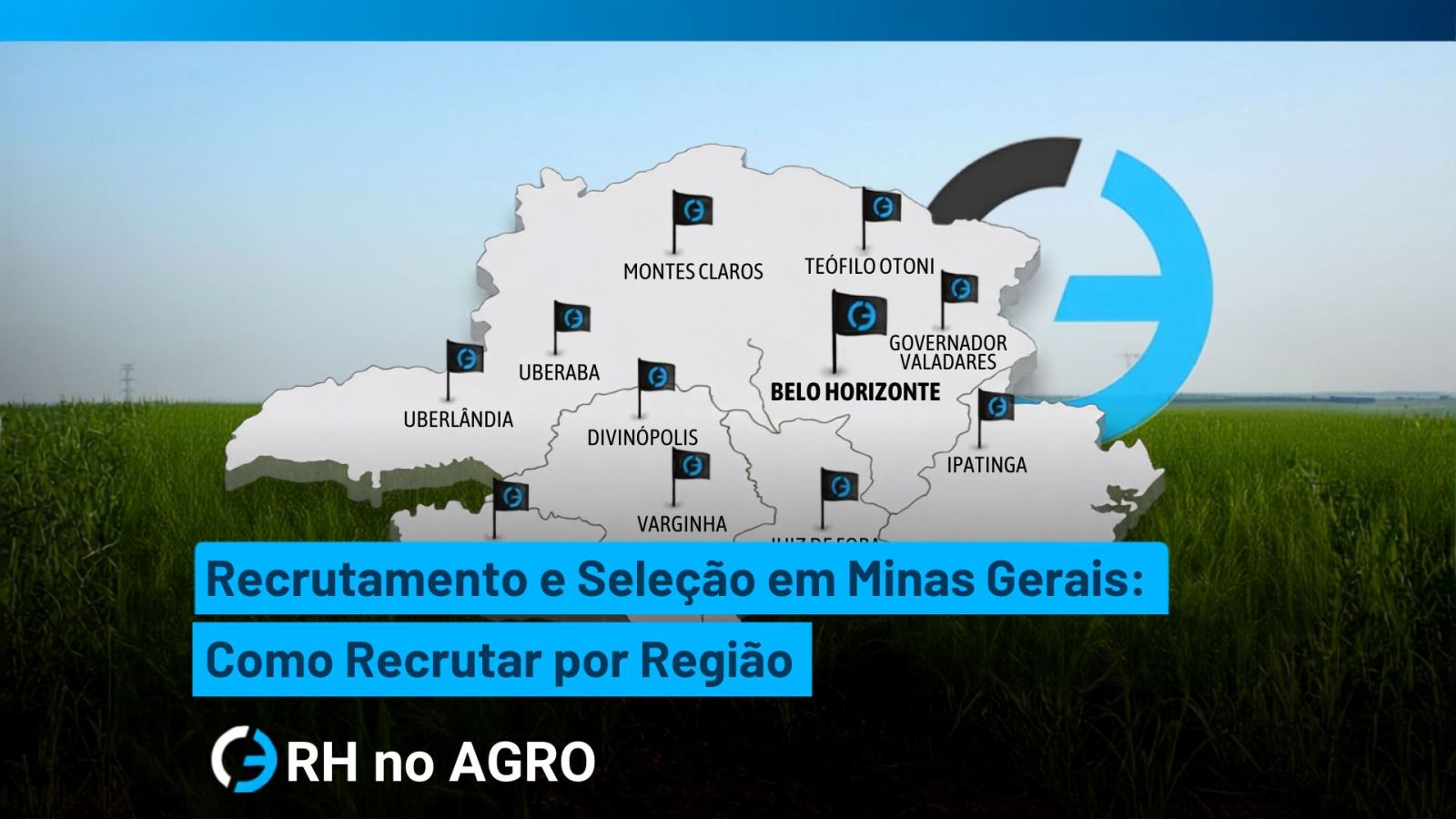
Recruitment and selection in Minas Gerais is a challenge of unusual scale in Brazilian agribusiness: the state is at the same time Brazil's largest producer of coffee and milk, one of the world's largest hubs of zebu cattle genetics and home to one of the country's most strategic logistics triangles. Finding a coffee farm manager in the Cerrado Mineiro requires a completely different technical profile from a dairy coordinator in the Zona da Mata or a grain operations manager in the Triângulo Mineiro.
This diversity is what makes Minas Gerais one of the most complex states for executive recruitment in the sector. There is no single "Minas Gerais market": there are at least four distinct regional economies, each with its own production chain, its own players and its own rural work culture. Understanding this economic geography before opening a position is what separates a generic selection process from executive recruitment that truly delivers results.
Looking at the state as a whole, this complexity can be organized into four major economic clusters, each with its own dominant vocation. This division is not official, but it is the most useful way to see Minas Gerais from the point of view of someone recruiting for agribusiness.
Uberlândia is the logistics gateway of agribusiness in the Triângulo Mineiro
The largest city in the Triângulo Mineiro, Uberlândia sits at the crossroads of strategic highways such as BR-050, BR-365 and BR-452, which has turned it into one of the country's largest hubs for the distribution and storage of inputs and grains. In this context, the city hosts Femec, an agricultural machinery and equipment fair expected to generate more than R$ 2.7 billion in business. For anyone doing recruitment and selection in Minas Gerais in this region, the most sought-after profiles are logistics, operations and agribusiness supply chain professionals, roles that require easy movement between industry, distributors and farmers.
Uberaba is Brazil's zebu capital and home to ABCZ
Uberaba is home to the Brazilian Association of Zebu Breeders (ABCZ) and holds ExpoZebu and ExpoGenética every year, the world's largest zebu cattle genetics events, bringing together buyers from dozens of countries. The city concentrates companies in animal genetics, artificial insemination and herd nutrition with high technical standards. Executive recruitment here usually involves veterinarians and animal scientists specialized in genetic improvement, a much rarer profile than that of traditional beef cattle ranching.
Frutal is one of the main sugar and ethanol hubs of the Triângulo Mineiro
In the far west of the Triângulo Mineiro, Frutal concentrates sugarcane processing mills focused on ethanol and sugar production, as well as a strong grain chain that supplies this agro-industry. It is a municipal economy less talked about than Uberlândia or Uberaba, but essential for anyone recruiting production engineers and agronomists specialized in sugarcane in the interior of Minas Gerais, roles in which competition for talent with the interior of São Paulo is direct.
Patrocínio is Brazil's largest coffee-producing municipality
Patrocínio is considered Brazil's largest coffee-producing municipality, at the heart of the Cerrado Mineiro region, the first coffee area in the country to receive a Designation of Origin from INPI, Brazil's intellectual property office. High-altitude coffee growing, under technology-intensive irrigation, has created constant demand for agronomists specialized in cup quality and certification, as well as farm managers used to large-scale operations. Recruitment and selection in Minas Gerais for this type of position requires assessing real experience with mechanized harvesting and post-harvest quality control.
São Gotardo is a national reference in potatoes, garlic and carrots under center pivots
São Gotardo leads, alongside neighboring municipalities such as Ibiá and Rio Paranaíba, a region that received a Geographical Indication from INPI for potatoes, garlic, carrots and avocados, thanks to an altitude between 800 and 1,350 meters that allows year-round planting under automated center-pivot irrigation. It is precision horticulture that requires agronomists with expertise in soil management, fertigation and traceability, profiles that are much more technical than those required in conventional vegetable growing.
Patos de Minas is the state's largest corn production hub
Known as Brazil's corn capital, Patos de Minas celebrates this vocation with Fenamilho, an agricultural festival that has received visits from state authorities and is one of the largest events of its kind in Minas Gerais, according to coverage by Agência Minas Gerais. The local corn and soybean chain sustains constant demand for agronomists, agricultural technicians and storage operators, with peaks of temporary hiring during harvest periods.
Unaí is the grain and cotton hub of Northwestern Minas
On the agricultural frontier with Goiás and the Federal District, Unaí is part of the Cerrado's advance into Northwestern Minas, with strong large-scale production of soybeans, corn and cotton. It is a region where the work culture is closer to agribusiness in Goiás than to the rest of Minas Gerais, which requires recruiters to be sensitive when assessing candidates used to extensive farm operations and managing large seasonal teams.
Montes Claros leads agribusiness in Northern Minas with irrigated fruit growing
The largest city in Northern Minas, Montes Claros works as a services and agro-industry center for a region marked by irrigated fruit-growing districts, especially mangoes and grapes near the São Francisco River. The city is also home to dairy industrial plants that supply much of the state. Recruitment and selection in Minas Gerais for this location means dealing with a more limited talent market than that of the Triângulo Mineiro, which usually calls for strategies to attract people from outside the region.
Varginha is Brazil's coffee capital and home to the Commodities Exchange
Varginha holds the title of Brazil's coffee capital because it is home to a dry port specialized in coffee exports, the Minas Gerais Commodities Exchange and the Council of Coffee Growers' Associations of Minas Gerais (CCCMG). The city also hosts international events such as the Varginha Coffee Journey, which takes foreign buyers to cooperatives and farms in Southern Minas. Recruitment and selection in Minas Gerais for this hub usually involves foreign trade, coffee grading and export logistics professionals, a rare mix outside this region.
Juiz de Fora sustains one of the most traditional dairy basins in Brazil
In the Zona da Mata of Minas Gerais, Juiz de Fora is the historic center of one of the oldest dairy basins in the country, a region that helped build Minas Gerais's reputation as Brazil's largest milk-producing state. Around the city, small and medium-sized farms still dominate production, which makes dairy technicians and veterinarians specialized in dairy cattle more sought after than in large-scale farming regions.
Fairs and events that drive agribusiness in Minas Gerais
As in São Paulo, Mato Grosso, Paraná, Goiás and Rio Grande do Sul, each hub in Minas Gerais has an annual event that works as a barometer of the local economy and brings together the sector's main decision-makers, a good indicator of where demand for talent intensifies each year.
What changes in executive recruitment for these regions
Recruitment and selection in Minas Gerais changes its technical nature with each hub visited, from the genetic rigor of the Triângulo Mineiro to the agronomic precision of the Cerrado Mineiro and the cooperative culture of the Zona da Mata dairy basin. A recruiter who does not understand these differences ends up assessing resumes by job title rather than by the real technical experience the hub requires.
This means checking, for example, whether a candidate for coffee farm management has already run mechanized harvesting at altitude, whether a zebu genetics professional has really taken part in auctions and judging, or whether a dairy technician is used to milk collection logistics on small farms, typical of the Zona da Mata. This level of depth is only possible with recruiters who specialize exclusively in agribusiness.
Most common mistakes when recruiting for agribusiness in Minas Gerais
Treating Minas Gerais as a single, homogeneous market: it ignores that the economic distance between the Triângulo Mineiro and the Zona da Mata is as great as between different states, with their own production chains and work cultures.
Confusing experience in conventional coffee with precision coffee under center pivots: a candidate strong in rain-fed coffee growing is not automatically qualified for the technology-intensive irrigation of the Cerrado Mineiro.
Underestimating the specialization required in zebu genetics: ordinary beef cattle professionals rarely have the technical knowledge in genetic improvement that Uberaba requires of its candidates.
Ignoring the small scale of dairy production in the Zona da Mata: treating this region with the same scale parameters as the Triângulo Mineiro leads to wrong expectations about the candidate's profile and routine.
Conclusion
Recruitment and selection in Minas Gerais requires recognizing that the state works as a mosaic of regional economies: coffee in the Cerrado Mineiro and Southern Minas, zebu genetics and logistics in the Triângulo, expanding grain production in the Alto Paranaíba and the Northwest, and one of the country's most traditional dairy basins in the Zona da Mata. Anyone who recruits without understanding these differences runs the risk of hiring a technically correct profile for the wrong position.
If your company needs to recruit strategic talent for agribusiness in Minas Gerais, Geração C3 can help. We specialize in recruitment and selection exclusively for Brazilian and Latin American agribusiness.